The 117-Basis-Point Gap Hiding on a Westside Jumbo Rate Sheet
Rates quoted as of 08/14/2026. Rates move daily, treat every number here as a snapshot, not a quote.
A jumbo rate sheet crossed my desk last week from RBC U.S. Mortgage, the mortgage division of City National Bank. Four products, one borrower, one day of pricing. Most people scan the bottom row, see 6.92% on the 30-year fixed, and close the file.
The interesting number is at the top.
The 7/6 ARM is priced at 5.75%. That is 117 basis points between the cheapest and the most expensive money on the same page, from the same bank, to the same borrower, on the same day, worth about $764 a month on a $1,000,000 loan.
What the sheet says
Every number assumes a $1,000,000 loan with 30% down on a one-unit owner-occupied California property, excellent credit, zero points, roughly a $1,428,571 purchase with $428,571 out of pocket.
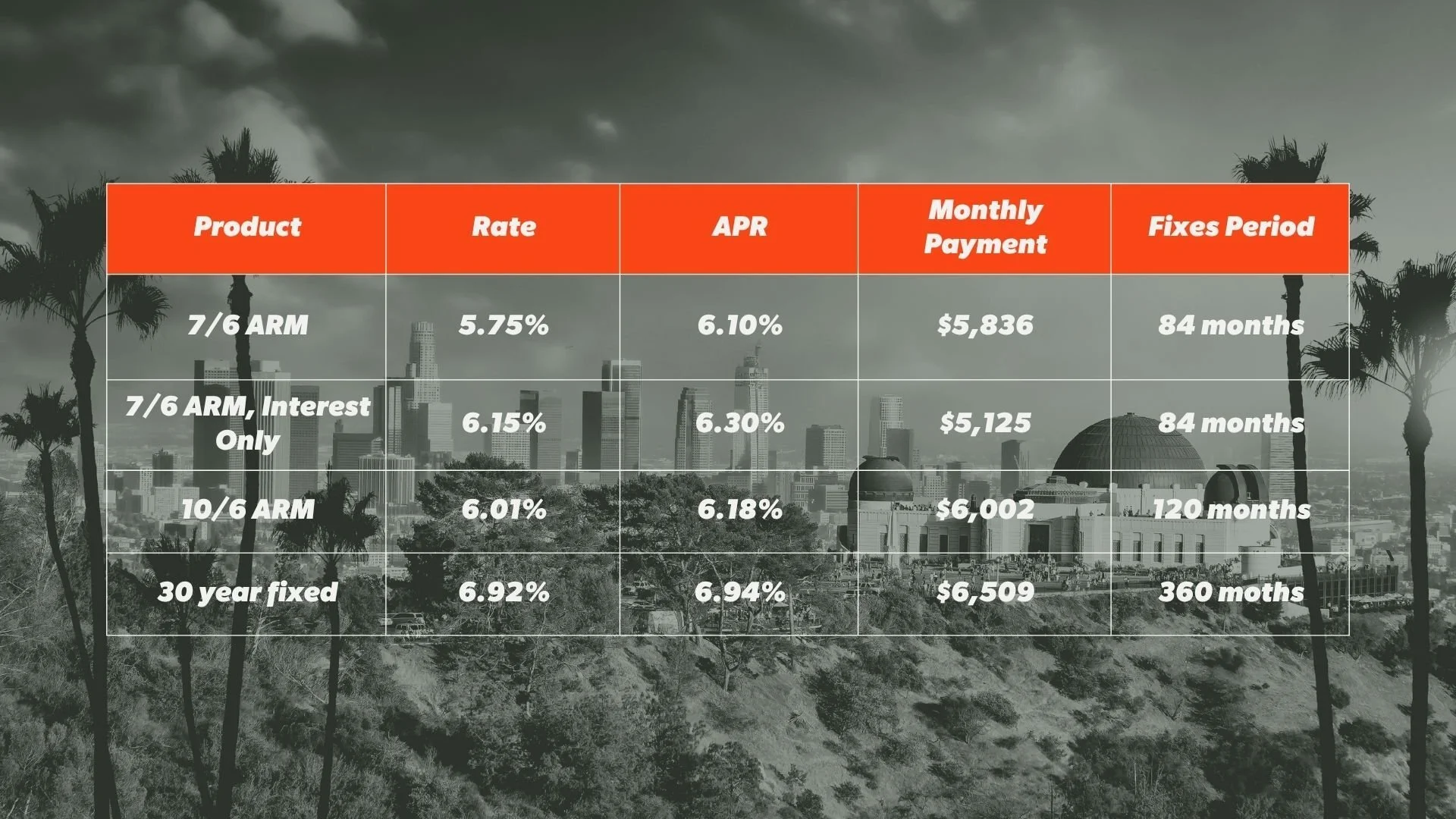
Each ARM shows an illustrated payment once the fixed period ends, all calculated at an assumed 6.38% fully-indexed rate: $6,170 on the 7-year/6-month, $6,915 on the interest-only, $6,180 on the 10/6.
I ran all of it, and every figure lands within a few dollars of the actual amortization. This is not a sheet playing games with its own math.
Where that pricing sits against the market
Freddie Mac put the 30-year fixed at 6.67% for the week ending August 13, 2026 (Freddie Mac PMMS). The Mortgage Bankers Association had the conforming 30-year at 6.77%, the jumbo 30-year at 6.71%, and the 5/1 ARM at 5.94% for the week ending August 14 (MBA).
The pattern: this sheet's fixed rate is priced above the national jumbo average while its ARM is priced below the national ARM average.
Banks that keep loans on their own balance sheet price ARMs aggressively because they want the asset, while fixed paper gets sold into the secondary market and prices to it.
At a mortgage banker or broker, that relationship often flips. Get quotes from both kinds of shop rather than three of the same kind.
What the 7/6 ARM is worth over seven years
The monthly savings are the obvious part, and the principal is the part almost nobody runs.
The payment gap is $764 a month, or $64,147 across 84 months. The lower rate also pushes more of every payment into principal, so after seven years the ARM borrower owes $892,335 against the fixed borrower's $910,335, an extra $17,999 knocked down.
Total seven-year advantage: about $82,146 on a $1,000,000 loan.
The reset is not a cliff either. At the assumed 6.38% index the payment moves from $5,836 to $6,170, which is still $429 below what the fixed-rate borrower has been paying the entire time.
The interest-only line:
The $5,125 payment is the lowest number on the sheet and the one most likely to be misread.
That figure is exactly 6.15% of $1,000,000 divided by 12, pure interest, not one dollar to principal, so after seven years you owe the same $1,000,000 you started with.
Run it against the fixed honestly. You save $123,848 in payments over 84 months, but you forgo $89,665 of principal the fixed-rate borrower accumulated, leaving a net advantage of about $34,183, and that is liquidity, not equity.
Then comes the reset, where the payment jumps from $5,125 to $6,915 because the full balance now has to amortize over the remaining 276 months. That is a 35% increase in a single month.
It is a legitimate tool for a buyer with lumpy income, or for someone who will genuinely deploy the freed cash above 6.15%. It is the wrong product for a buyer who needs $5,125 to make the deal work, because in 84 months they will need $6,915.
If you cannot comfortably carry the reset payment today, the reset payment is your real payment.
The 10/6 is the quiet one
At 6.01% it costs 26 basis points more than the 7/6 and buys three more years of certainty, saving $597 a month and $71,694 over ten years, plus $19,421 of extra principal, about $91,115 over the decade.
For a buyer who intends to live in the house rather than trade it, three more years of a fixed payment for 26 basis points is cheap insurance.
What the sheet does not tell you
The caps are missing. The 6.38% illustration is today's index plus margin, not a ceiling. What actually limits your risk is the cap structure, how far the rate can move at the first adjustment, at each one after, and over the life of the loan, and those numbers are not on this page. On a 7/6 they are frequently 5/1/5, which would put a lifetime ceiling around 10.75% on a 5.75% start rate. Get the caps in writing, because that figure is what you are really underwriting yourself against.
The illustrated reset is below today's fixed rate. The sheet's own worst case looks benign because 6.38% is lower than 6.92%. That is a real argument in the ARM's favor and also a reason for caution, since it makes the downside feel already priced in when it is not.
The relationship discount expires exactly when you need it. On adjustable loans it applies only during the initial fixed-rate period, and qualifying assets have to be in an eligible account before the Closing Disclosure issues. Move the money early.
This is 30% down, not 20%. All of this pricing sits at 70% LTV, and a buyer at 80% or 90% will see meaningfully different numbers on jumbo.
What it means if you are buying
Scale it up, because $1,428,571 is a Mar Vista condo rather than the number most of my clients work with. At the same rates, the 7/6 ARM saves $1,527 a month on a $2,000,000 loan, $2,291 on $3,000,000, and $3,055 on $4,000,000, roughly $128,000, $192,000, and $257,000 across seven years.
Fair caveat: pricing at $3M is not necessarily the pricing quoted at $1M, and above a certain loan size portfolio banks underwrite the relationship as much as the property.
Here is the version that changes behavior. Hold the payment constant instead of the loan, and a $6,599 monthly payment that supports $1,000,000 at 6.92% supports about $1,131,000 at 5.75%, 13% more loan for the identical payment, or roughly 9% more house once you hold the down payment flat. Nine percent is the difference between losing a house and buying it.
What it means if you are selling
ARMs were 7.7% of all applications for the week ending August 14, 2026 (MBA), more than nine out of ten borrowers defaulting to the most expensive product on the sheet.
Some of that is rational, because plenty of people belong in a fixed loan. But some share of the buyers who walked your open house and decided your price did not work were pricing off a 6.92% payment when a 5.75% payment was available at the same bank that afternoon.
No ARM rescues a listing sitting 15% over the comps. If your home is drawing traffic and stalling on affordability rather than condition, though, the constraint may be softer than the buyer thinks, with the caveat that ARM qualification is often tighter, not looser.
How to actually decide
The question is not "ARM or fixed," it is how long is your money staying in this house.
Under seven years, the ARM is likely correct and the fixed is an expensive hedge against a risk you will never live to see. Fifteen years, take the fixed and stop optimizing, because certainty is what you are buying. If the answer is "I don't know," the 10/6 is where I would look first.
And if the plan is "I'll refinance before the reset," interrogate that, because it is the most common assumption in lending and the one that has aged worst (Mortgage Professional America). A refinance is an option, not a plan.
Frequently asked questions
What is a 7/6 ARM? The rate is fixed for the first 7 years, then adjusts every 6 months for the remaining 23 years based on an index plus a fixed margin.
Is an ARM cheaper than a 30-year fixed in 2026? On the initial rate, generally yes, on this August 2026 sheet the 7/6 ARM was 117 basis points below the fixed. Whether it is cheaper overall depends entirely on how long you hold the loan.
How much does a 7/6 ARM save on a $1,000,000 loan? Roughly $82,146 over the 7-year fixed period — $764 a month in payment savings plus about $17,999 in additional principal paid down.
Is an interest-only mortgage a good idea? It is a cash-flow instrument rather than a savings one. You build zero equity during the interest-only period, and the payment jumps from $5,125 to $6,915 when it ends, a 35% increase. It fits irregular income, not a buyer who needs the lower payment to qualify.
What is a relationship rate discount? A rate reduction for holding qualifying assets at the bank. The assets usually must be in an eligible account before the Closing Disclosure issues, and on adjustable loans the discount often applies only during the initial fixed period, disappearing exactly when your rate starts moving.
Do jumbo loans have higher rates than conforming loans? Not always, and lately often the reverse, MBA had jumbo at 6.71% against conforming at 6.77% for the week ending August 14, 2026. Jumbo pricing varies far more by lender, so shopping matters more at higher loan amounts.
I am a real estate broker, not a mortgage lender. Nothing here is a rate quote, a loan offer, or an endorsement of any lender or product. The figures come from one lender's published rate sheet dated 08/14/2026 for a specific borrower profile, and rates change daily. Request an official Loan Estimate before choosing a loan.
Paul Salazar | Paul Salazar Group at Compass | DRE #01763227