Should You Wait Another Year to Sell Your Los Angeles Home?
Short answer: waiting only pays off if your home appreciates more than it costs you to keep owning it. On the Westside, that bar is higher than most homeowners think, usually 2–3% appreciation a year just to break even. Below is the math almost nobody runs before deciding to "give it another year."
The Question Most Homeowners Ask (And the One They Should)
I get some version of this call every week: "Paul, should I sell now or wait a year?"
It's a fair question. But buried inside it is an assumption, that the only variable that matters is whether prices go up. Prices are one line in the equation. There are about six others, and a few of them are working against you the entire time you wait.
Appreciation Is Not a Flat Rate Applied Evenly to Every House
Los Angeles real estate has gone up over long stretches of time. That's the headline. The fine print is that appreciation shows up unevenly, by neighborhood, by price tier, by how ready your house actually is for a buyer.
A renovated, well-positioned home in Mar Vista and a dated one three blocks away do not appreciate at the same rate. They don't even compete for the same buyer. Venice canal homes move on lifestyle psychology. Marina del Rey waterfront condos have their own microeconomics entirely and shouldn't be compared to a standard single-family comp.
So the real question isn't "will LA prices be higher next year?" It's "will my house, on my street, in its current condition, appreciate enough to justify twelve more months of ownership?"
Those are very different questions, and only one of them has a useful answer.
Meanwhile, the Bills Show Up Regardless
Your house doesn't know you have a timing strategy. It just keeps costing money. Here's an illustrative year of carrying costs on a $2.5M Westside home:
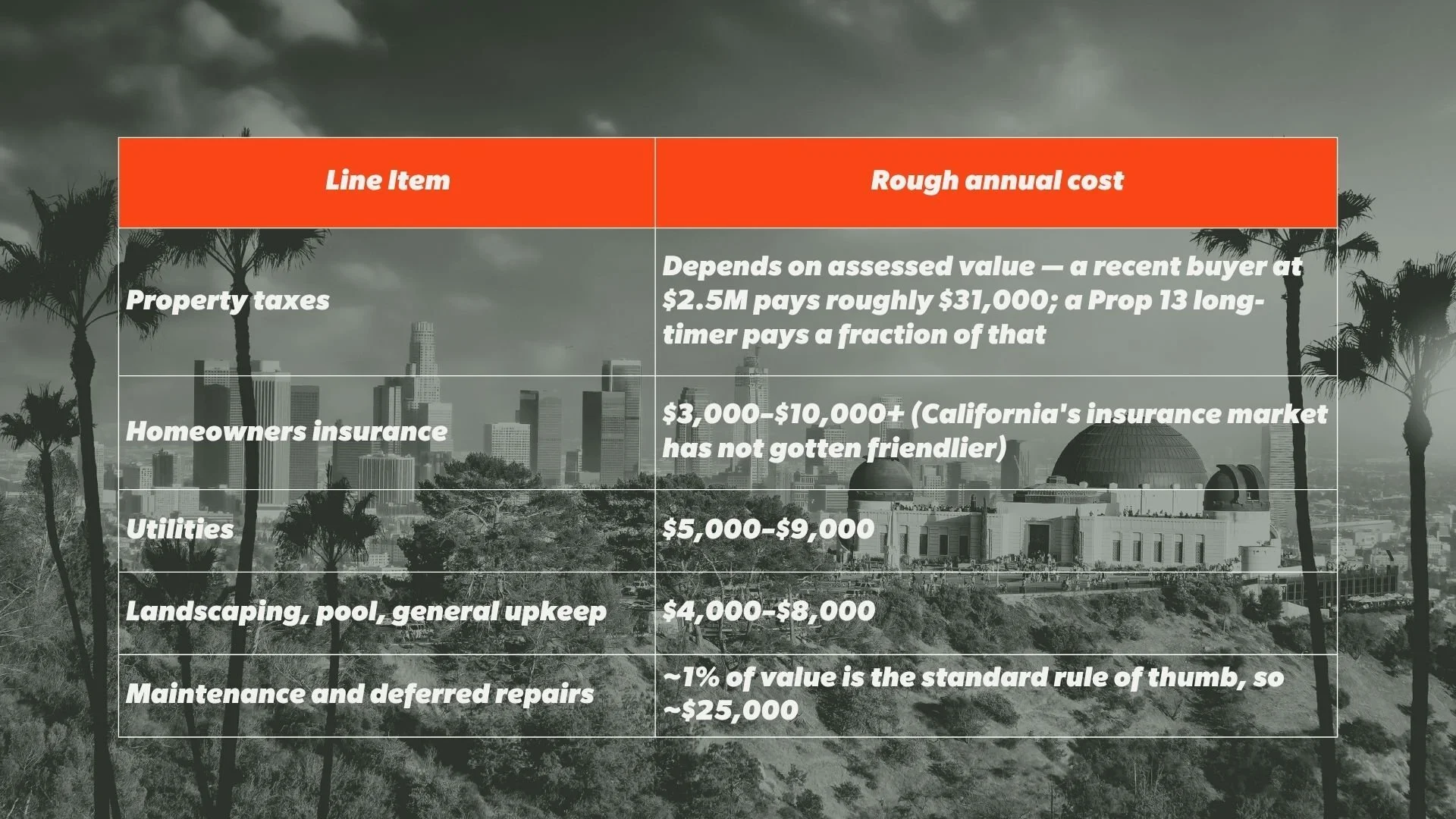
Depending on when you bought, you're somewhere between roughly $35,000 and $80,000 for the privilege of waiting. Run that against your value. If you're carrying $60,000 a year on a $2.5M home, your home needs to appreciate about 2.4% before you've made a single dollar. Appreciation below that number isn't a gain. It's a slower loss.
(These are illustrative ranges, not a quote on your property. Prop 13 makes property tax wildly different house to house, your actual number could be far lower.)
Lower Rates Help You. They Also Help Every Other Seller.
The affordability argument for waiting goes like this: rates come down, buyers come back, competition heats up, prices rise. That's half the story. The other half is that the same rate drop unlocks the sellers who have been sitting on 3% mortgages refusing to move. When they get comfortable, they list.
Waiting a year isn't a bet on appreciation. It's a stacked bet on interest rates and buyer demand and inventory and the broader economy all breaking your way at the same time. That's four coin flips, not one.
Your Biggest Competitor Next Spring Is Your Neighbor
Inventory is the variable I'd watch most closely. A lot of Westside homeowners have postponed selling, low locked-in rates, uncertainty, no clear replacement property. That's a backlog. And backlogs don't release gradually, they release the moment confidence returns.
More inventory means more choices for buyers, more competition among sellers, longer days on market, tighter pricing strategy, and more negotiating once you're in escrow. A house that stands out in a thin market can get lost in a full one. You don't just want a good market. You want a good position in it.
The Market Doesn't Know What's Going On in Your Life
Here's what 20+ years has taught me: the homeowners with the best outcomes weren't the ones who nailed the top of the market. They were the ones whose sale lined up with their actual life.
Retirement. Downsizing. A job in another state. An estate to settle. A portfolio to rebalance. Those forces almost always outweigh the last half-percent of appreciation you were holding out for, and they don't wait for a Fed announcement.
A Better Question to Ask Yourself
Stop asking "Will my home be worth more next year?" Ask this instead: "If my home's value were exactly the same twelve months from now, would waiting still make sense?"
If yes, great, you have real reasons and you should wait with confidence. If the only thing propping up the decision is a hoped-for price bump, you've built a plan on a number nobody can promise you.
Paul's Take
Nobody knows where the LA market lands twelve months out. Values may rise. Rates may fall. Inventory may flood. I'm not going to pretend otherwise, and you should be skeptical of any agent who does.
What you can do is evaluate the things that are knowable right now: what your home is actually worth today, what it costs you to hold, what's coming to market around you, and what you're trying to accomplish with your life. The goal was never to time the market perfectly. The goal is to make the decision with the full picture instead of half of it.
FAQ
Is 2026 a good year to sell a home in Los Angeles? It depends far less on the calendar than on your specific property, your neighborhood's current inventory, and your reason for moving. Homes that are move-in ready and priced to the current comps are still transacting well on the Westside; dated homes in crowded price tiers need a sharper strategy.
How much does it cost to hold onto a house for another year? Between property taxes, insurance, utilities, upkeep, maintenance, and HOA dues where applicable, most Westside homeowners are looking at roughly $35,000–$80,000 a year, depending on assessed value and property size.
Will home prices in LA go up next year? Nobody can tell you that with certainty. The more useful question is whether your specific home would appreciate enough to cover a year of carrying costs, typically 2–3%.
What if my home didn't sell last time I listed it? That's usually a pricing or positioning problem, not a market verdict. Relaunching expired listings is a large part of what my team does, the same house, marketed differently, often produces a very different result.
Should I wait for interest rates to drop before selling? Lower rates bring out more buyers, but they also bring out more sellers. If inventory rises alongside demand, the advantage can cancel out.
Curious how this math works on your specific address? I'll run the real numbers on your property, current value, carrying costs, what's competing with you, and what waiting would actually cost, and give you a straight answer either way.
About Paul
Paul Salazar | Estates Director, Compass $800M+ sold | 20+ years on the Westside | Listing agent for Mar Vista's record $10M sale at 11948 Modjeska Place | 310.853.3643 | info@paulsalazargroup.com