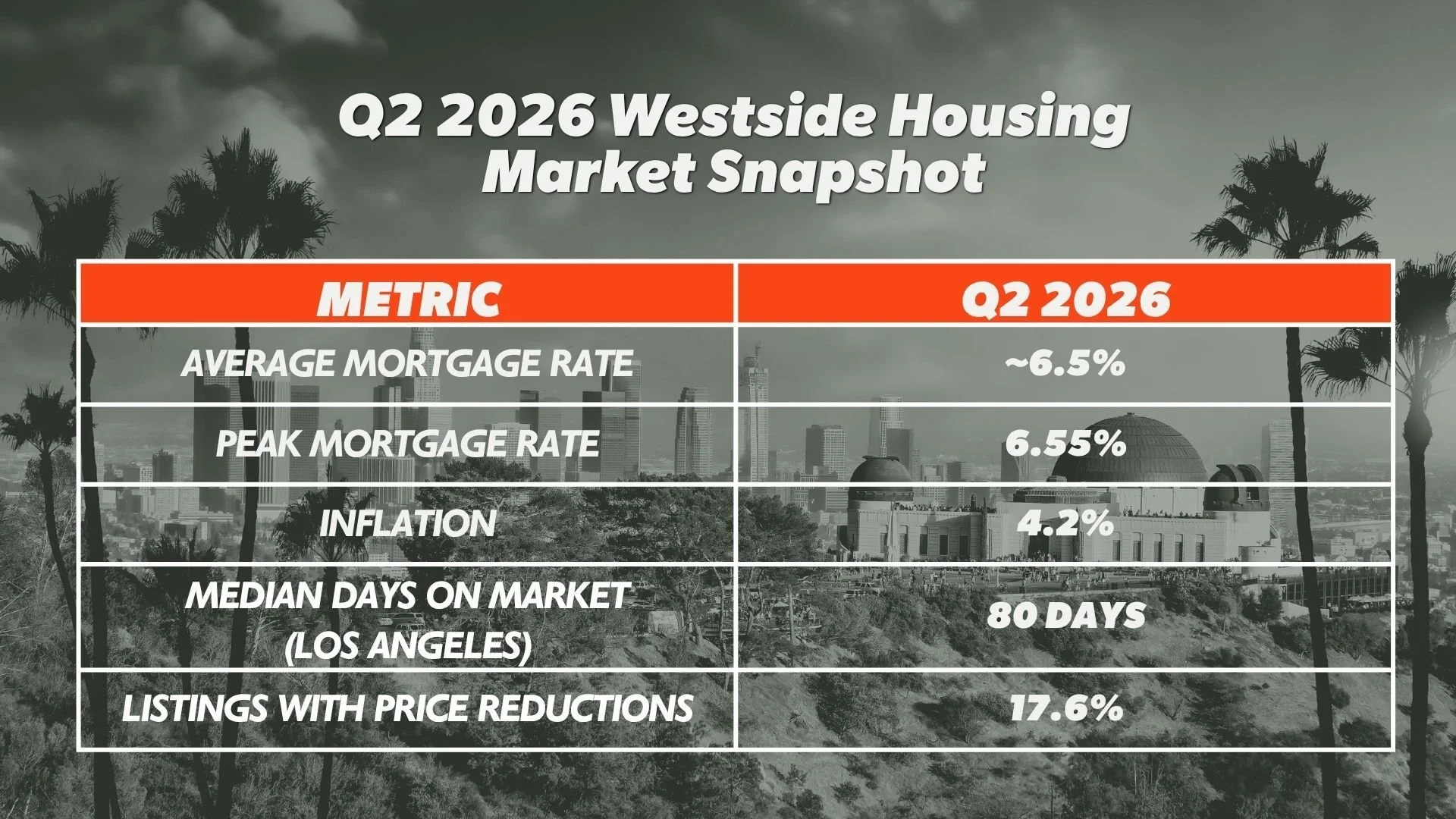
The Westside Los Angeles housing market in Q2 2026 was defined by a single number: 6.5%. That's where mortgage rates spent most of April, May, and June, roughly half a point above where they started the year, after the Iran war disrupted global energy markets and pushed bond yields higher.
The result wasn't a housing crash. It was a market that paused, recalibrated, and is now beginning to move again.
This analysis explains how the Iran war affected mortgage rates, buyer demand, and home values across Brentwood, Mar Vista, Venice, Santa Monica, Marina del Rey, Pacific Palisades, and the broader Westside Los Angeles housing market during Q2 2026.
What Happened to Mortgage Rates in Q2 2026?
The setup matters. Mortgage rates had finally dipped below 6% for the first time in more than three years when the Iran war began on February 28. The subsequent disruption in the Strait of Hormuz pushed oil prices above $100 per barrel, reigniting inflation concerns and driving bond yields higher.
From there, Q2 became a rate roller coaster. Inflation accelerated to 4.2%, its highest reading in three years. Mortgage rates climbed into the mid-6% range during April, briefly eased following the ceasefire announcement, and then moved higher again as uncertainty surrounding the truce persisted. By the end of the quarter, Freddie Mac's weekly survey showed mortgage rates touching 6.55%, their highest level in nearly a year.
At the same time, expectations that the Federal Reserve would begin cutting interest rates disappeared. Instead, policymakers kept rates unchanged while monitoring inflation and geopolitical developments.
Appraiser Jonathan Miller summarized the quarter well in The Real Deal: the market wasn't canceled, it was delayed by roughly a month.
That delay had real financial consequences. As one Los Angeles agent told the Los Angeles Times, buyers who locked a mortgage around 6.1% late last year would have paid roughly $200 less per month on a $1 million loan than buyers waiting until spring.
How Did Higher Mortgage Rates Affect the Westside Los Angeles Housing Market?
The Los Angeles Times described the local market accurately: the war froze a market that was already moving cautiously.
Los Angeles County recorded just 3,072 home sales in January, the lowest monthly total in three years. By February, the median listing was spending 80 days on the market, the longest in roughly five years, while 17.6% of listings were reducing their asking prices.
Mortgage rates, however, were only one part of the story. Higher homeowners insurance costs, elevated construction expenses, and continued weakness in Hollywood employment also weighed on buyer confidence throughout the quarter.
Yet the impact wasn't evenly distributed. The buyer most affected by rising mortgage rates is the financed, payment-sensitive buyer, a buyer who dominates much of Los Angeles County. The Westside luxury market operates differently.
In neighborhoods including Brentwood, Mar Vista, Venice, Santa Monica, Marina del Rey, and Pacific Palisades, many buyers either pay cash or use financing strategically rather than out of necessity. That distinction mattered. Rather than disappearing, buyers simply became more selective. Homes priced appropriately continued attracting offers. Listings priced for February's lower-rate environment sat considerably longer.
What I'm Seeing on the Ground Across the Westside
The statistic that deserves more attention is one many people overlooked. According to the Los Angeles Times, new escrows across Los Angeles County have increased by as much as 50% in recent weeks compared with the prior month.
Because closed-sale data typically trails actual market activity by 30 to 60 days, today's headlines are often describing yesterday's market. That's consistent with what I'm seeing throughout the Westside.
Many buyers who paused during March returned during May and June. They're more analytical than before, paying closer attention to comparable sales and showing far less willingness to stretch beyond market value.
Meanwhile, well-capitalized buyers have found meaningful negotiating opportunities as sellers who spent months waiting became increasingly willing to adjust on price. The market isn't returning to the urgency of 2021. It's becoming healthier, more rational, and more price-sensitive.
Westside Los Angeles Housing Market Outlook for Summer 2026
As we move into the second half of 2026, the biggest question isn't whether the market survived the Iran war. It did. The bigger question is how quickly confidence returns if mortgage rates stabilize.
The recent increase in escrow activity suggests buyers are already adapting to today's financing environment. If rates remain near current levels rather than moving materially higher, the delayed spring market could continue carrying momentum through summer. That makes pricing strategy more important than ever.
Is Now a Good Time to Buy or Sell on the Westside of Los Angeles?
If you're selling
Price your home for today's 6.5% mortgage-rate environment, not February's sub-6% market. Buyers remain active, but they're far less forgiving of aspirational pricing. Properly priced homes continue selling while overpriced listings accumulate days on market.
If you're buying
If you're purchasing with cash or strong financing, today's market continues to offer negotiating leverage. However, the recent increase in escrow activity suggests that opportunity may not remain open indefinitely. Trying to perfectly time a geopolitical event or interest-rate cycle has historically been less effective than buying the right property at the right price.
Bottom Line
Q2 2026 wasn't the quarter that fundamentally changed Westside Los Angeles home values. It was the quarter that changed buyer psychology. Higher mortgage rates slowed decision-making, but they didn't eliminate demand. Buyers adjusted. Sellers adjusted. The market continued moving, just more selectively.
If you're considering buying or selling in Brentwood, Mar Vista, Venice, Santa Monica, Marina del Rey, or Pacific Palisades, understanding what's happening beneath the headlines matters far more than reacting to them.
If you'd like to discuss your property's current value or the latest buyer activity in your neighborhood, call or text me at 310-387-1976.

Frequently Asked Questions
Did the Iran war crash the Los Angeles housing market?
No. The Iran war slowed buyer activity by pushing mortgage rates higher, but it did not cause a housing crash. Instead, the market experienced a temporary delay before buyer demand began returning.
How did the Iran war affect mortgage rates?
The conflict increased geopolitical uncertainty, pushed oil prices above $100 per barrel, fueled inflation concerns, and contributed to mortgage rates averaging roughly 6.5% during Q2 2026.
Why did mortgage rates rise during Q2 2026?
Mortgage rates increased because investors demanded higher bond yields amid rising inflation, energy-price shocks, and expectations that the Federal Reserve would delay interest-rate cuts.
What were mortgage rates at the end of Q2 2026?
Freddie Mac's weekly survey placed the average 30-year fixed mortgage rate at approximately 6.55%, the highest level in nearly a year.
Did Westside Los Angeles home prices fall?
Not broadly. Higher mortgage rates reduced buyer activity, but desirable Westside neighborhoods remained relatively resilient. Market conditions favored accurately priced homes over overpriced listings.
Which Westside neighborhoods held up best?
Luxury areas such as Brentwood, Mar Vista, Venice, Santa Monica, Marina del Rey, and Pacific Palisades generally performed better because many buyers rely less on financing than buyers in lower price ranges.
Is now a good time to buy a home on the Westside?
For buyers with cash or strong financing, today's market still offers negotiating opportunities. However, increasing escrow activity suggests those opportunities may narrow if demand continues improving.
Is now a good time to sell on the Westside?
Ye, provided the home is priced for today's mortgage-rate environment. Homes priced according to current market conditions continue attracting buyers, while aspirational pricing often results in extended time on market.
Why are public home sales data behind the market?
Closed-sale data usually lags buyer activity by 30 to 60 days because transactions must first enter escrow before eventually closing. New escrow activity often provides an earlier indication of changing market conditions.
What does this mean for the Westside Los Angeles housing market in the second half of 2026?
If mortgage rates stabilize, the delayed spring market could continue supporting buyer activity through the summer and into the second half of 2026. The market appears to be adjusting to higher borrowing costs rather than collapsing.