Can Your Swimming Pool Save Your House From a Wildfire? An LA Fire Captain Explains
When the Palisades burned, daylight turned to night, the canyon sounded like a freight train, and fire trucks couldn't reach half the houses on the street. Here's the part nobody talks about: most of those homes were sitting on 20,000 gallons of water, a swimming pool, the equivalent of 40 fire engines, and couldn't use a single drop of it.
How I Found This Story: A Sign on Kenter Avenue
I was heading to a property on Kenter in Brentwood when I spotted an unfamiliar sign in a front yard, like an ADT placard, but for something called Fire Defense Services. I asked the homeowner about it. She walked me straight into her garage and showed me a machine that looked like a barbecue but was actually a patented fire pump connected to her swimming pool.
I sell in the Very High Fire Hazard Zones, most of Bel Air, most of Brentwood, the Palisades, and parts of Santa Monica. The question buyers ask about hillside homes has changed. It's no longer just "how's the view?" It's "is this house actually defensible?" So I brought Jim into the studio to answer that.
Who Is Jim Prabhu?
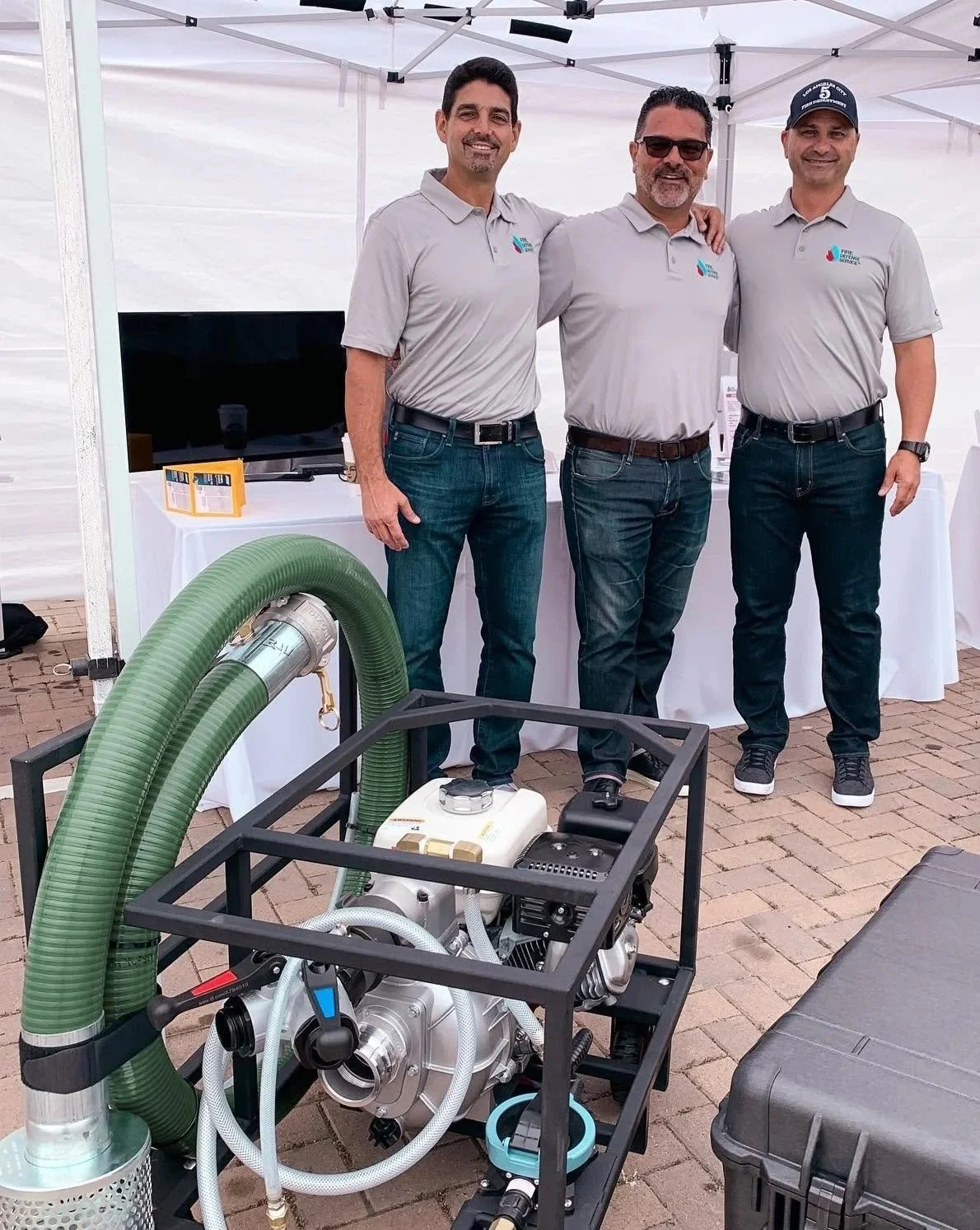
Jim is a fire captain with LA City Fire , 26 years on the department, assigned to Station 71 at Sunset and Beverly Glen in Bel Air. He grew up in Malibu, where fire wasn't a once-in-a-lifetime event; it was a season. As a kid, his parents would evacuate the family to Point Dume, then go back and beat down embers with wet towels. They saved the house more than once. In January 2025, he was on the initial dispatch into the Palisades Fire, where for the first hour all his crew did was evacuate people.
After the Woolsey Fire, Jim and his family founded Fire Defense Services. His cousin had rigged a small pool pump with old fire hose and saved his own property; a friend up PCH did the same and saved his neighbor's too. They knew the concept worked. The problem was everything around it.
What the System Actually Is
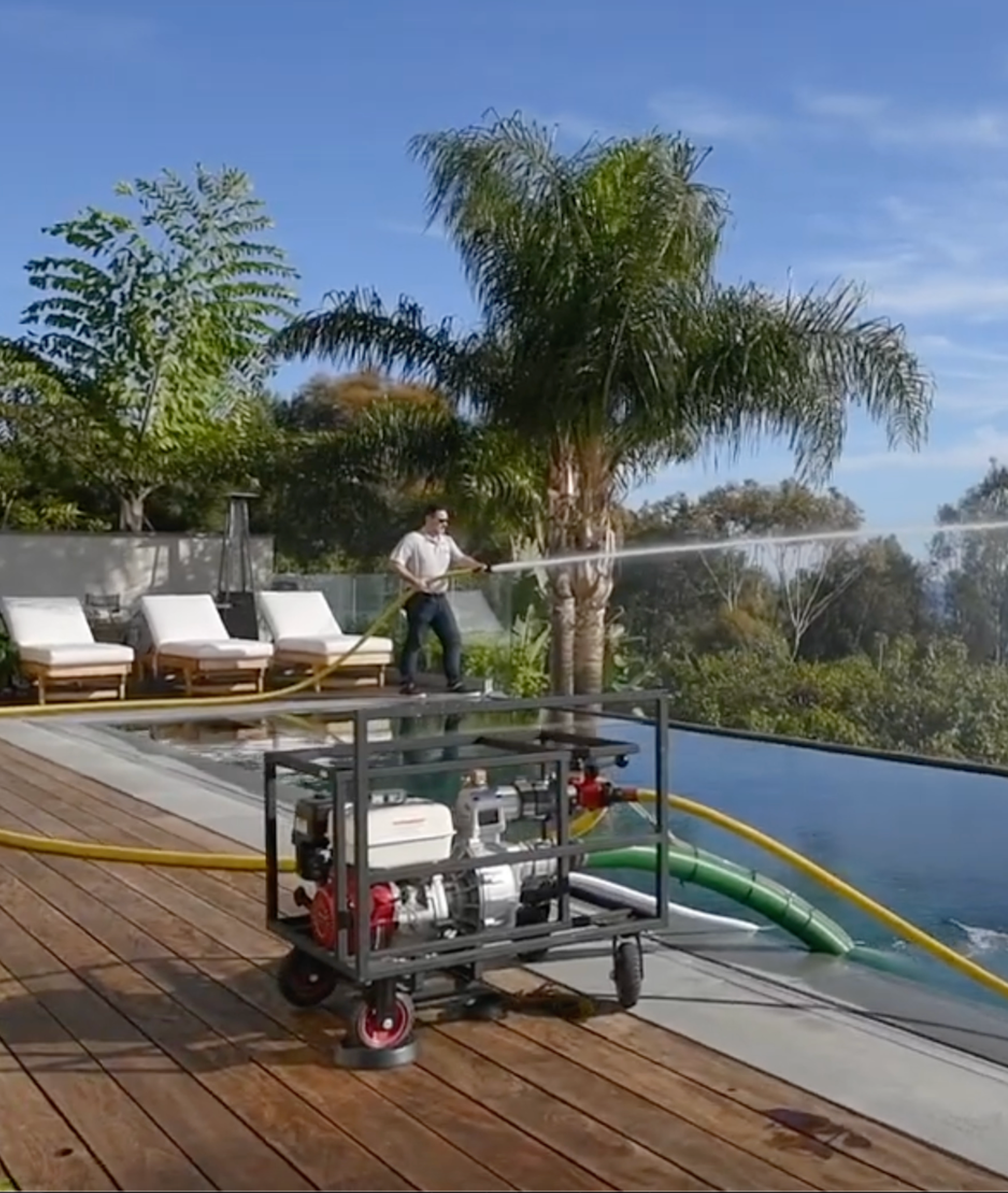
Fire Defense Services builds a patented, custom-fabricated pump unit that turns your swimming pool (or water tank) into a firefighting water source. A few things separate it from the DIY setups Jim has seen fail across California:
Same equipment as LAFD. The hose, nozzles, and fittings are identical to what's in the brush bags on Jim's own engine, deliberate, so arriving firefighters already know how to use it and trust that it works.
A built-in intercooler line. Without cool water constantly flowing through, a pump's impeller heats the water into steam and seizes. Most homeowners with garage-bought pumps have no idea. Jim's system solves it by design.
The "ember dome." Jim is blunt about rooftop sprinklers: he's stood on fires where they ran on the roof while the house burned from the inside, and in 80–90 mph Santa Ana winds, that water blows into the street. His system flips it: ground-mounted nozzles, backs to the wind, spraying a fog pattern that rides the wind toward the house and knocks down embers before they land. That matters because Palisades houses didn't burn from a wall of flame, they burned from embers launched miles ahead, landing in dry mulch, wood fences, and patio cushions.
It's unmanned-capable. Deploy it, set the fog pattern, and leave. One of Jim's clients in the Highlands got a text from him the moment the Palisades dispatch came in: "Deploy your system." He did, and saved his house and his neighbors'. Firefighters used it afterward to mop up hot spots.
The time to prepare for the emergency is not during the emergency.
Why They Rent Instead of Sell
This detail matters more than any spec sheet. Fire Defense Services doesn't sell pumps, they lease them, because the number one reason home fire pumps fail is neglect. Jim has met homeowners whose pumps had never seen oil or gasoline. Hoses rotted. Rats chewed through equipment. Fuel went bad.
So twice a year, they come out, fire it up, flow water through it, and run it on ethanol-free fuel that doesn't degrade. If anything's off, they swap in a new pump on the spot.
The numbers: entry-level systems start around $350/month, with most clients at $400–500/month per pump on a one-year contract. Larger properties may need two, three, or more, one Bel Air client runs five. No upfront installation cost. A detailed home-hardening assessment report from a certified inspector runs about $750.
The Insurance Angle: Why That $750 Report Might Be the Best Money You Spend
If you own in a Very High Fire Hazard Zone, you know what's happened to premiums. Owners who bought 15–20 years ago and paid a few hundred a year now face $1,000+ per month on a $3–4M house, and $50K to $200K a year at the top of the market. Many have been pushed onto the FAIR Plan.
Insurance companies are laser-focused on home hardening, and documentation is leverage. Jim told me about a Westlake-area client whose broker showed up to drop his coverage. The client walked him to the backyard, showed him the pump system and the assessment report, and kept his insurance. The company is also working with a Napa broker who packages the pump system plus private firefighters for wineries, specifically to bring to underwriters.
Every carrier is different, and nobody can promise a discount. But a maintained system plus a professional hardening report gives your broker something concrete to fight with, to keep your coverage or bring your premium down while your neighbors are getting dropped.
Home Hardening: The Cheap Stuff That Actually Works
Some of the highest-impact moves cost almost nothing:
Ember screens. Any vent or opening into your house should have 1/8" to 1/16" mesh. Jim recently toured a nearly fireproof concrete-and-steel winery, except for a quarter-inch vent mesh that would have let embers burn it down from the inside. The fix was a finer screen. That's it.
Remove Italian cypress. The one tree Jim tells every client to take out. Green outside, bone-dry needles inside, they ignite fast and throw a massive ember cast.
Create space in Zone Zero. The area immediately around your house, what researcher Jack Cohen coined the "home ignition zone." Pull vegetation off the walls, trim trees 10 feet back, clear the leaves, and swap flammable mulch for rock.
Think about urban fuels. Wood fences, dry mulch, patio cushions, these carried fire house-to-house on El Medio during the Palisades Fire, not the hillside brush.
What If You're Not Home?
Fair question, plenty of owners up here have multiple properties. Fire Defense Services has partnered with SRP24 (Strategic Response Partners), private firefighters who deploy to your home during a fire, prep it, seal openings, run air scrubbers, and operate the pump. Notably, SRP24 only sends crews to houses with the Fire Defense system installed, because they know it's maintained and will start.
The Question Buyers Are Asking Now
I've watched the conversation shift in real time. In Bel Air, Brentwood, the Palisades, and the hillside pockets of Santa Monica, defensibility is becoming part of the value conversation, the way seismic retrofits did after Northridge. A home with a maintained water-source system, documented hardening, and a workable insurance story is simply an easier home to buy, own, and eventually sell.
And Jim's cousin has a line I haven't stopped thinking about: the time to prepare for the emergency is not during the emergency.
If nothing else, do this today: build a go bag (clothes, medications, documents, passports), know which heirloom you're grabbing, talk to your neighbors about a street-level plan, and decide in advance whether you'll stay or leave. If you're leaving, leave early.
Watch the full interview with Captain Jim Prabhu on Paul Salazar Group YouTube channel.

FAQ
How much water does a swimming pool provide for firefighting? The average Southern California pool holds roughly 20,000 gallons. A standard LA city fire engine carries 500, so a typical pool equals about 40 engines' worth of water on your property.
How much does a pool fire pump system cost? Fire Defense Services leases systems starting around $350/month, most clients paying $400–500/month per pump on a one-year contract, with twice-yearly maintenance included and no upfront installation cost.
Do rooftop sprinkler systems protect a house from wildfire? According to Captain Prabhu, generally no. In high winds the water blows away from the house, and homes frequently burn from the inside via embers entering through vents. Ground-based fog-pattern nozzles that use the wind to create a protective "ember dome" are more effective, paired with ember-resistant vent screens.
Can a fire pump system lower my home insurance premium? It can help. Every carrier is different, but a professionally maintained system plus a documented home-hardening assessment has helped homeowners keep coverage they were about to lose, concrete evidence your broker can bring to underwriters.
What is Zone Zero? The area immediately surrounding your home, the home ignition zone. Keeping it free of vegetation, mulch, and flammable materials is one of the cheapest, most effective ways to protect a house from ember-driven ignition.
What should homeowners in Very High Fire Hazard Zones do first? Install fine mesh (1/8"–1/16") ember screens on all vents, remove Italian cypress trees, trim trees 10 feet from the house, clear Zone Zero, build a go bag, and make an evacuation plan before fire season, not during it.