Why Home Insurance Is Quietly Setting Westside LA Home Prices in 2026
Starting October 15th, every California FAIR Plan policy that renews gets hit with an average increase of 29.1%, the largest in the plan's recent history, across roughly 700,000 policies statewide.
Everyone is watching mortgage rates and inventory. Meanwhile, the number actually moving Westside prices is sitting on page four of an insurance binder.
Key takeaways
High-fire-zone premiums on the Westside run roughly $10,000 to $30,000 a year, and two homes on the same street can land at opposite ends of that range.
The FAIR Plan caps dwelling coverage at $3 million, which doesn't rebuild most Westside homes, forcing owners into a stacked policy structure.
A $10,000 annual premium gap erases about $128,000 of what a buyer can borrow at today's rates.
California buyers can now cancel escrow over insurance alone, using a stand-alone contingency in the purchase agreement.
Homes outside high fire zones are appreciating relative to comparable homes inside them, and it isn't showing up in any appraisal line item.
How much does home insurance cost in a Westside high fire zone?
Roughly $10,000 to $30,000 a year. Where you land inside it depends on the property, the brush around it, the condition of your roof and vents, and how much coverage you're willing to carry. Two houses on the same street can sit at opposite ends of that range, which is the part homeowners find hardest to believe until their own quote arrives.
What does the California FAIR Plan actually cover?
Less than most people assume. The FAIR Plan is a last-resort fire policy, and its base coverage runs to fire, smoke, lightning and internal explosion. It doesn't include liability, theft, water damage or loss of use, which is why the California Department of Insurance advises homeowners to buy a separate Difference in Conditions policy to fill the gaps. In practice that means most Westside owners in high fire zones carry two policies at once, which is why people quote their insurance as a single combined number that sounds startling out of context.
Why the $3 million FAIR Plan cap is a problem for Westside homes
Here's what catches high-end owners off guard. The FAIR Plan writes a maximum of $3 million on a dwelling, a limit the Insurance Commissioner set back in 2019 and hasn't revisited since.
Builders are quoting close to $1,000 a foot in the Palisades right now, so $3 million doesn't rebuild a 4,000-square-foot house. That leaves you stacking the FAIR Plan, plus the wrap, plus an excess layer above $3 million, paying specialty pricing at every level of the structure.
And the exposure is remarkably concentrated. Bloomberg found that just 9 ZIP codes out of more than 1,700 statewide account for about 7% of everything the FAIR Plan is on the hook to pay, roughly $44 billion, including Beverly Hills, Bel Air and Malibu. Less than 1% of the state's ZIP codes are carrying 7% of the risk. So when you read that the FAIR Plan is under pressure, a meaningful share of that pressure is coming from our backyard.
How does home insurance affect what a buyer can pay?
This is the mechanism nobody explains, and it's just arithmetic. Buyers don't buy prices, they buy payments, and the insurance premium lives inside the payment. The 30-year fixed is sitting around 6.76%, which means every $1,000 of monthly payment supports roughly $154,000 of loan.
Now picture two buyers with identical budgets:
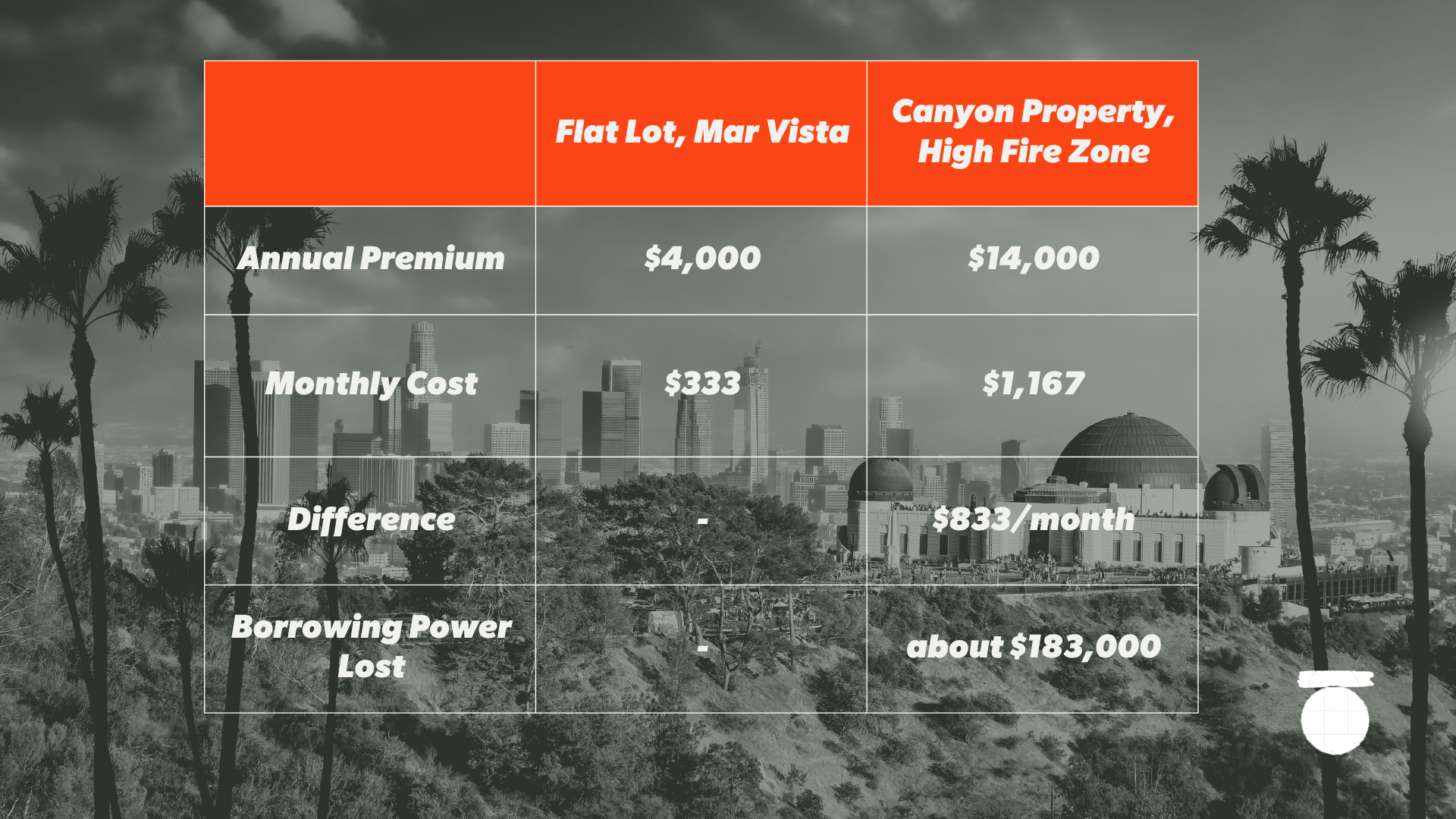
That second buyer is absorbing an extra $833 a month before they've turned on a light. The buyer never says "I'm offering less because of your insurance." They just come in lower, and the seller concludes the market softened.
Which Westside homes are gaining value because of insurance?
The ones outside the high fire zones, and it's happening quietly enough that nobody has named it.
If your home insures at normal rates with an admitted carrier, buyers can simply afford to pay more for it. Nobody writes that into an offer and no appraiser has a line item for it, but it shows up in what people are willing to pay.
Insurability has become a comp variable. Two houses on the same street, same vintage, same finishes, where one insures at $4,500 with an admitted carrier and the other needs an $18,000 stack, are not worth the same number anymore. Most of the market is still pricing as though they are.
Can a buyer cancel escrow because of insurance in California?
Yes, and this is newer than most homeowners realize. The California Association of Realtors built a stand-alone insurance contingency into the residential purchase agreement, so a buyer can cancel on insurance alone rather than folding it into the investigation contingency.
It's a real right buyers didn't used to have, and it's being used. Over 20 years on the Westside, the point where deals die has migrated from the appraisal, to the loan, and now to a phone call with an underwriter about two weeks into escrow.
What is Zone 0 and when does it take effect in California?
Zone 0 is the first 5 feet around your house, and on August 19, 2026, the California Board of Forestry voted 8-0 to approve the first Zone 0 defensible space rules in the country.
The rules still have to clear the Office of Administrative Law, which the state expects around the end of September 2026. Once published, existing homes get 3 years for the first phase and up to 5 years for full compliance.
Here's the part that matters commercially: carriers have been underwriting to that standard for months already. The owners who do the work now and document it will price better than the ones who wait to be told.
There's stability arriving from the other direction too. Under the settlement between the Department of Insurance, Consumer Watchdog and State Farm that received final approval in July, the company's 17% homeowners increase stands, but it agreed to extend its moratorium on non-renewals for at least another year.
What Westside sellers and buyers should do right now
Selling in the next 12 months? Get a bindable quote in writing before you list. If the number is ugly, solve it on your terms rather than letting a buyer discover it two weeks into escrow and reprice your house for you.
Do the mitigation work and document it. Clear the first 5 feet, handle the roof and the vents and the defensible space, and ask your broker specifically about mitigation credits. A documented file is what moves a house off the FAIR Plan and back into the admitted market.
Buying? Order the insurance quote in the first week of escrow, and never remove a contingency without it in hand.
Not in a high fire zone at all? You're holding something the market is repricing upward. That binder is a selling feature, market it like one.
Frequently Asked Questions
How do I find out if my home is in a high fire zone?
CAL FIRE publishes Fire Hazard Severity Zone maps, and mapped addresses fall into moderate, high or very high categories. Your insurance broker can pull yours in about a minute, and it's worth knowing before you list rather than after an underwriter tells you.
Can I get off the California FAIR Plan and back to a regular insurer?
Often yes, and that's the goal. Admitted carriers are writing again in parts of the Westside, and what moves a file is documentation, a recent roof, ember-resistant vents, cleared defensible space, and photos proving all of it. The owners who get requoted successfully are almost always the ones with a paper trail.
What is a DIC or wrap policy?
Difference in Conditions is the companion policy you buy alongside the FAIR Plan to cover what it leaves out, mainly liability, theft, water damage and loss of use. Most Westside owners in high fire zones carry both.
Does my insurance quote affect my home's appraisal?
Not directly, since appraisers work from comparable sales rather than carrying costs. But it affects what buyers can qualify for and what they'll offer, which eventually shows up in the comps themselves. That lag is where a lot of sellers are currently sitting.
Will California home insurance rates come down?
Nobody can promise that, but the direction has improved. Carriers are re-entering the state, State Farm has agreed to hold off on non-renewals for at least another year, and FAIR Plan growth has slowed considerably from its 2024 and 2025 pace. Rates falling and coverage becoming available again are two different things, and availability is improving faster.
Should I do the Zone 0 work before it's legally required?
If you're planning to sell, yes. Carriers are underwriting to that standard regardless of the enforcement date, so the work affects your premium now and your buyer's premium later. Waiting until it's mandatory means doing it under a deadline alongside everyone else in your ZIP code.
Find out where your street actually stands
Insurance and pricing have become the same conversation, and most Westside owners are only looking at half of it. To know more about this reach out to us at info@paulsalazargroup.com.