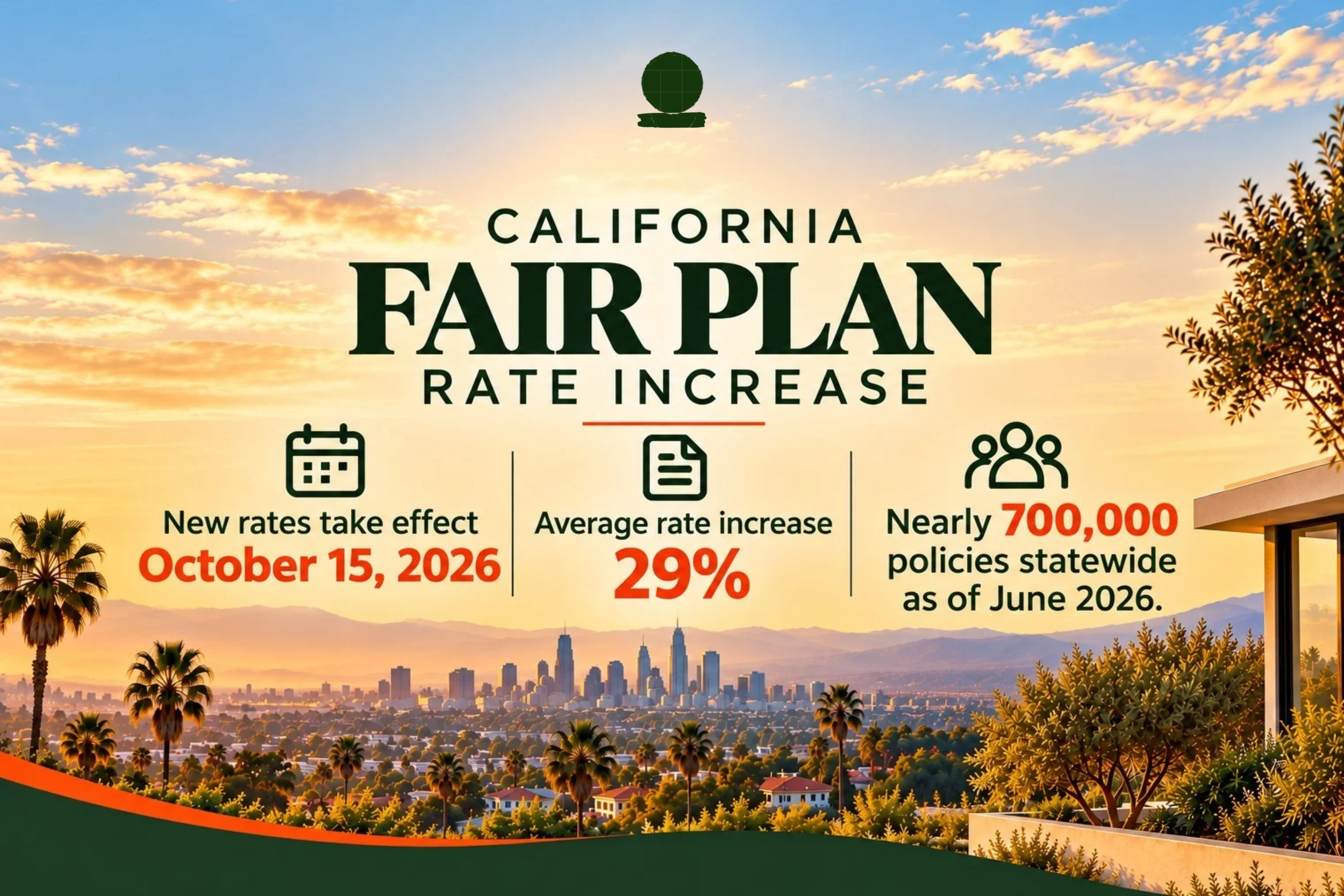
The California FAIR Plan’s 29.1% average rate increase took effect on October 15, 2026, and it applies to new and renewing dwelling policies across the state. For homeowners in Westside Los Angeles, including Pacific Palisades, Brentwood, Bel Air, Mar Vista, Venice and Santa Monica, the actual change depends far more on the specific property than on that statewide average.
How much is the California FAIR Plan rate increase in 2026?
The California Department of Insurance approved an average increase of 29.1% after the FAIR Plan asked for 35.8%. It is the largest approved increase the plan has taken in recent history, compared with roughly 20% in 2019 and about 16% in both 2021 and 2023.
When does the new FAIR Plan rate take effect?
The new rates apply to any FAIR Plan policy written or renewed on or after October 15, 2026. If your renewal date fell before October 15, you keep your current rate until your next renewal.
Will every FAIR Plan policy go up 29.1%?
No. Depending on the property, individual changes range from an 80% decrease to a 200% increase. Most of the increase sits in the wildfire portion of the premium, so homes backed up to brush and canyons take the biggest hit, while some lower-risk homes will actually pay less.
Why did the FAIR Plan raise rates?
The FAIR Plan was built as a small backstop for a few hard-to-insure homes. As of June 2026, it covers 696,562 policies with about $768 billion of exposure. The January 2025 Palisades and Eaton fires cost the plan an estimated $4 billion and forced a $1 billion assessment on the insurance companies that back it. The plan’s own filing estimated it needed a much larger increase than the one it received.
How does the FAIR Plan increase affect Westside Los Angeles homes?
Los Angeles County has more FAIR Plan policies than any other county in California: about 154,765 as of September 2025, up 83% in four years (MoneyGeek). On the Westside, I see that number split into two very different groups.
In Pacific Palisades, the Brentwood hills, Mandeville Canyon and Bel Air, the FAIR Plan is often the main fire policy, and I expect those homes to see increases above the average. In Mar Vista, Venice, Santa Monica and the flatter parts of Brentwood, many of my clients landed on the FAIR Plan only because a carrier didn’t renew them, and some of them may see a much smaller change, or even a decrease.
What does the FAIR Plan not cover?
The FAIR Plan covers fire only. You still need a separate difference-in-conditions (DIC) policy for liability, water damage and theft, and about 43% of FAIR Plan customers now carry one (United Policyholders). The FAIR Plan’s dwelling coverage also stops at $3 million, which is below the rebuild cost of many Westside homes. For most of my clients, the real annual insurance cost is FAIR plus DIC plus excess coverage, and that total is the number that belongs in a budget.
Can you get off the FAIR Plan in 2026?
For the first time in three years, there may be a path. On September 16, 2026, State Farm filed to accept new homeowners applications for the first time since May 2023, limited to homes with an IBHS Wildfire Prepared Home designation. Allstate filed on August 31 to reopen for the first time since 2022 (California Department of Insurance). State Farm is aiming to begin in December if regulators approve, with a cap of 7,500 new applications a year (Yahoo Finance). As of this week, neither filing has been approved.
What should Westside buyers, sellers and homeowners do now?
Here’s how I’m advising clients right now:
If you’re on the FAIR Plan, call your broker 60 days before renewal and shop the private market. Ask about the plan’s wildfire mitigation discounts, which top out around 16% off the wildfire portion of the premium.
If you’re selling in a hillside or brush area, get insurance quotes before you list and include them in the disclosure package. A known cost is much easier for a buyer to accept than an unknown one.
If you’re buying, get an insurance quote before you submit an offer, and lock it in during your inspection period.
Could FAIR Plan rates go up again?
Yes. The FAIR Plan must submit a new rate filing at least every two years, and California elects a new insurance commissioner on November 3, 2026 (CalMatters). I wouldn’t assume this is the last increase.
Let’s Talk!
If you want to know what insurance actually costs on your home, or on one you’re thinking about buying in Westside Los Angeles, reach out and I’ll walk you through it. Call or text 310-853-2643 or email info@paulsalazargroup.com.
Frequently Asked Questions
How much did California FAIR Plan rates go up in October 2026?
California FAIR Plan rates went up an average of 29.1% on October 15, 2026, for new and renewing dwelling policies. Individual changes range from an 80% decrease to a 200% increase depending on the property’s wildfire risk.
Does the FAIR Plan rate increase affect Pacific Palisades and Brentwood homes?
Yes. Pacific Palisades and hillside Brentwood homes with high wildfire exposure are likely to see FAIR Plan increases above the 29.1% average, because most of the increase is tied to the wildfire portion of the premium.
When does the FAIR Plan rate increase apply to my policy?
The FAIR Plan rate increase applies at your first renewal on or after October 15, 2026. If your policy renewed before that date, your current rate stays in place until your next renewal.
What is the FAIR Plan coverage limit for Los Angeles homes?
The California FAIR Plan’s dwelling coverage limit is $3 million, which is below the rebuild cost of many Westside Los Angeles homes. Owners above that limit typically add excess coverage plus a difference-in-conditions policy.
Is State Farm writing new homeowners policies in California?
Not yet. State Farm filed in September 2026 to resume writing new California homeowners policies for wildfire-certified homes, with a target start of December 2026 if approved. Allstate has also filed to reopen, and both filings are still under review.