Despite another round of disappointing inflation reports, there was some encouraging news for mortgage rates last week. Treasury yields moved meaningfully lower, reversing part of their recent climb. Here’s what happened and what it could mean for buyers and homeowners.
This Week’s Jumbo Purchase Rates
According to this week’s jumbo purchase rate sheet from a private bank lender we work with, dated October 16, 2026, here’s where rates stand on a $1,000,000 loan:
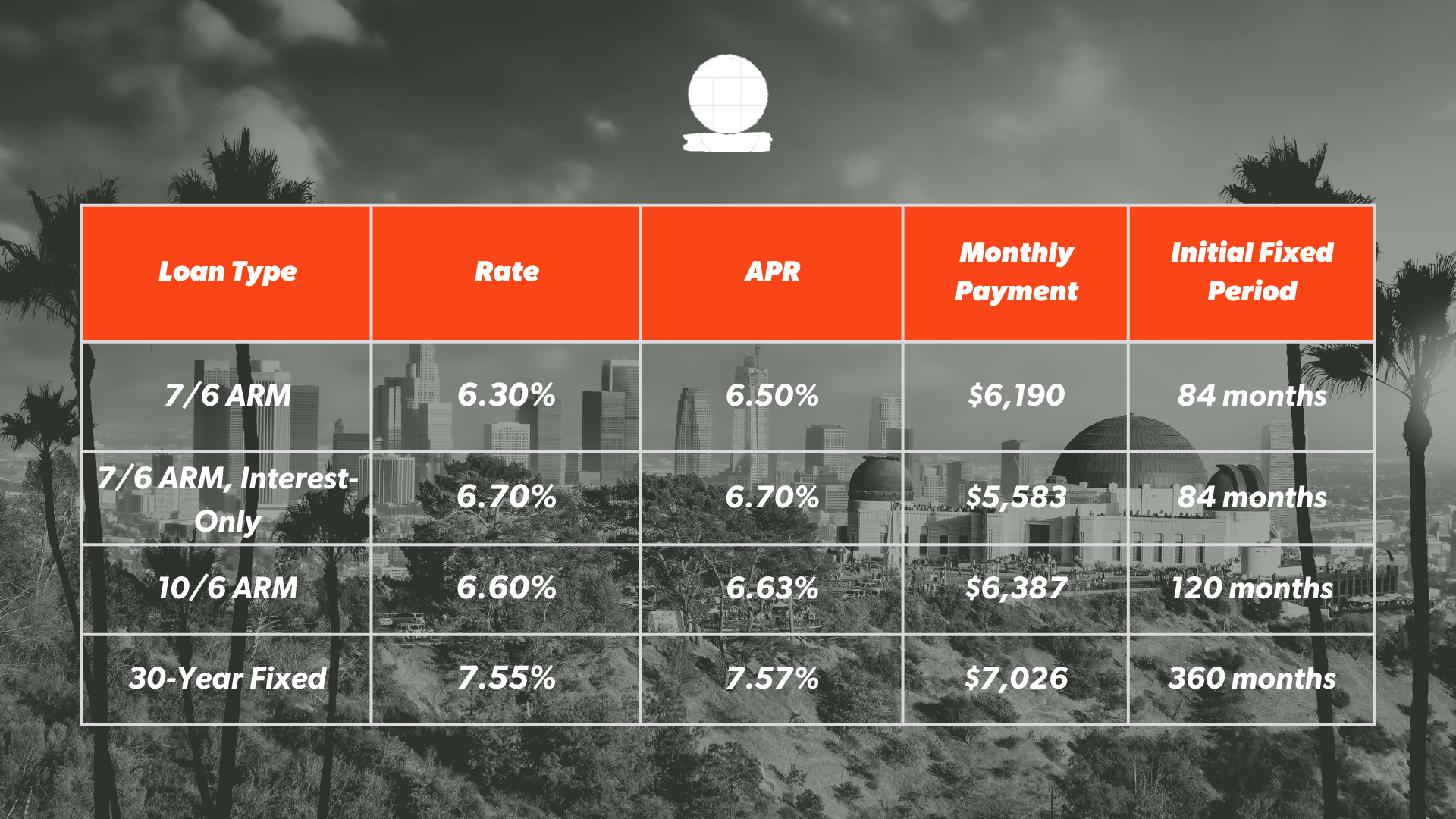
Payments shown are principal and interest only and don’t include property taxes or insurance. Your own rate will depend on your loan size, down payment, credit and relationship with the lender, so treat these as a snapshot rather than a quote.
Mortgage Rates May Finally Be Finding Some Relief
The national average 30-year fixed mortgage rate held steady at 7.40% according to Freddie Mac, ending 7 consecutive weeks of increases (Freddie Mac). More importantly, the 10-year Treasury yield, which mortgage rates tend to follow more closely than the Fed’s rate, declined from 5.24% to 5.09% last week, a meaningful drop of 0.15 percentage points. That improvement came despite hotter inflation reports, as investors shifted money out of riskier technology stocks and into the relative safety of Treasury bonds. If this trend continues, it could provide some welcome relief to mortgage rates in the weeks ahead. For borrowers, 7- and 10-year adjustable-rate mortgages remain particularly worth a look. On this week’s rate sheet, the 7/6 ARM sits a full 1.25 percentage points below the 30-year fixed, while still giving you 7 years of payment stability before the rate can adjust.
Inflation Came in Hotter Than Expected
September’s Consumer Price Index rose 0.6% for the month, bringing annual inflation to 3.7%, up from 3.4% in August. Core inflation, which excludes food and energy, rose to 2.6% annually. Wholesale inflation was even more concerning, with the Producer Price Index up 1.3% in September and 6.3% over the past year, its largest annual increase since December 2022 (BLS). Much of that increase was driven by energy costs, which shows how much the Middle East conflict continues to affect the U.S. economy.
Oil Prices Remain a Wild Card
Brent crude finished last week near $110 per barrel as continued disruptions around the Strait of Hormuz raised concerns about global energy supplies (EnergyNow). Higher oil prices affect much more than what we pay at the pump, because they raise transportation, manufacturing and shipping costs, which can keep inflation elevated and mortgage rates under pressure. A meaningful de-escalation in the Middle East could be one of the most important catalysts for lower rates.
Consumer Spending Remains Surprisingly Strong
Despite higher prices, U.S. retail sales rose 0.8% in September, well ahead of economists’ expectations, and spending was 6.3% higher than a year earlier. While that suggests the economy remains resilient, much of the increase reflects consumers paying more for gasoline rather than buying more goods. Strong spending supports growth, but it can also make the Fed’s job of controlling inflation more difficult.
What to Expect from the Fed
The Federal Reserve meets again October 27–28, and markets currently favor keeping rates unchanged at 3.75%–4.00% after September’s increase. Investors are increasingly focused on whether another increase could come in December.
What This Means for Buyers
The gap between ARMs and fixed rates is where the real money is right now. On a $2,000,000 purchase with 30% down, a $1,400,000 loan at this week’s 7.55% 30-year fixed works out to roughly $9,836 per month in principal and interest, while the 7/6 ARM at 6.30% comes in around $8,666. That’s about $1,170 less per month, or roughly $98,000 over the 7-year fixed period. On a $3,000,000 purchase with the same 30% down, the difference grows to about $1,756 per month.
The tradeoff is that an ARM can adjust after the initial period, so it fits best if you expect to sell, refinance or pay down the loan within that window. That’s a conversation to have with your lender. Buyers also have more room to negotiate than they did earlier in the year. With rates elevated, a seller credit toward a rate buydown or closing costs is a realistic ask on many listings, and it can sometimes do more for your monthly payment than a straight price reduction.
What This Means for Sellers
Today’s buyers are payment-focused, which means pricing correctly from day one matters more than ever. Homes that launch at the right number still move, while overpriced listings tend to sit and invite deeper cuts later. If you’re preparing to list, it’s worth thinking about whether offering a credit toward a buyer’s rate buydown could widen your buyer pool more effectively than lowering the price.
Bottom Line
Last week’s decline in Treasury yields is encouraging, particularly because it happened despite unfavorable inflation data. However, elevated oil prices and persistent inflation mean we should continue to expect some volatility. For buyers, the combination of greater negotiating opportunities and competitive adjustable-rate financing can still make this an attractive environment to purchase, particularly for those planning to hold their financing for an extended period.
Let’s Connect!
If you’re weighing a purchase, I’m happy to walk through what this week’s rates mean for your budget and connect you with a lender I trust. If you’re thinking about selling, I can share what buyers are asking for right now and how to price for it. Call or text 310-853-2643 or email info@paulsalazargroup.com.
Frequently Asked Questions
Why did mortgage rates stop rising this week?
The 10-year Treasury yield fell about 0.15 percentage points as investors moved money from tech stocks into bonds, and mortgage rates tend to track that yield.
Are adjustable-rate mortgages a good option right now?
This week’s 7/6 ARM is priced well below the 30-year fixed, which can mean meaningful monthly savings. Whether it fits depends on how long you plan to hold the loan, so talk it through with a licensed lender.
Will the Fed raise rates in October?
Markets currently expect the Fed to hold at 3.75% - 4.00% at its October 27 - 28 meeting, with more attention on a possible December increase.
How do oil prices affect mortgage rates?
Higher oil prices push up inflation across the economy, which keeps upward pressure on Treasury yields and, in turn, mortgage rates.
Should I wait for rates to drop before buying on the Westside?
Waiting can mean more competition if rates fall. Right now buyers have more negotiating room, and seller credits toward a buydown can lower your effective rate today.
Paul Salazar is a licensed real estate agent, not a mortgage lender. Rates shown are for informational purposes only, reflect a single lender’s rate sheet dated October 16, 2026, and will vary by borrower. Consult a licensed mortgage professional for a personal quote. DRE #01763227.