Mortgage Rates Hit 7%: What It Means for Westside LA Buyers and Sellers
If you've been waiting for mortgage rates to come down before buying in Santa Monica, Brentwood, Venice, or Mar Vista, I have some news. The average 30-year fixed rate climbed to 7.03% last week, up from 6.95% the week before and 6.30% a year ago (Freddie Mac). That's the highest reading since January 2025 (TheStreet).
I'm not a lender, but I've spent more than 20 years helping buyers and sellers on the Westside of Los Angeles. What I can do is tell you what's pushing rates around, what it means for your next move, and where buyers are still finding breathing room.
Why Are Mortgage Rates Going Up? The Fed Actually Raised Rates
For most of the last two years, the conversation was about when the Fed would cut. That script flipped on September 16, when the Fed raised its benchmark rate by 0.25% to a range of 3.75% to 4% (Federal Reserve). It was the first hike since 2023, and most Fed officials signaled they expect one more before the end of the year (Advisor Perspectives).
Here's the part most people get mixed up. The Fed doesn't set your mortgage rate. Mortgage rates follow the 10-year Treasury yield, which moves based on what investors think inflation and the economy will do next. The Fed's decision matters because it tells those investors how seriously it's taking inflation, and right now the answer is "very."
The Economy Keeps Refusing to Slow Down
Normally, rates come down when the economy cools off. The problem is that the economy didn't get the memo.
New home sales jumped 6.4% in August to an annual pace of 684,000 homes, and the supply of new homes for sale dropped from 9.0 months to 8.5 months (U.S. Census Bureau). In fairness, the Census Bureau itself says that monthly jump falls within its margin of error. What it does tell us is that buyers haven't disappeared. They're still out there, they're just a lot more focused on price and monthly payment than they were a few years ago.
Businesses are spending too. Orders for core business equipment, a closely watched measure of company investment, rose 1.6% in August, driven in large part by AI and data center buildouts (KPMG). That's good news for the economy, but a strong economy gives the Fed less reason to back off, and it keeps bond investors nervous about inflation. Good news for the economy, in other words, has been bad news for mortgage rates.
What Could Move Mortgage Rates This Week?
Two reports land this week, and they're the ones to watch. On Wednesday, September 30, we get the August PCE report, which is the Fed's preferred inflation gauge. On Friday, October 2, we will get the September jobs report (Kiplinger).
The simple version is this. If inflation comes in cooler and hiring slows down, Treasury yields have room to drift lower and mortgage rates could get some relief. If both come in hot, expect rates to stay where they are or push higher. Either way, if you're in escrow or about to be, this is a good week to have a conversation with your lender about when to lock.
Jumbo Mortgage Rates in Los Angeles: ARM vs. 30-Year Fixed
Here's where it gets more interesting for Westside buyers. Most homes in Santa Monica, Brentwood, Pacific Palisades, Venice, and Mar Vista require a jumbo loan, and jumbo pricing doesn't always track the national headlines.
I looked at a jumbo rate sheet from a private bank dated September 25, 2026. The example is a $1,000,000 loan for an owner-occupied home in California with 30% down, and the numbers tell a clear story.
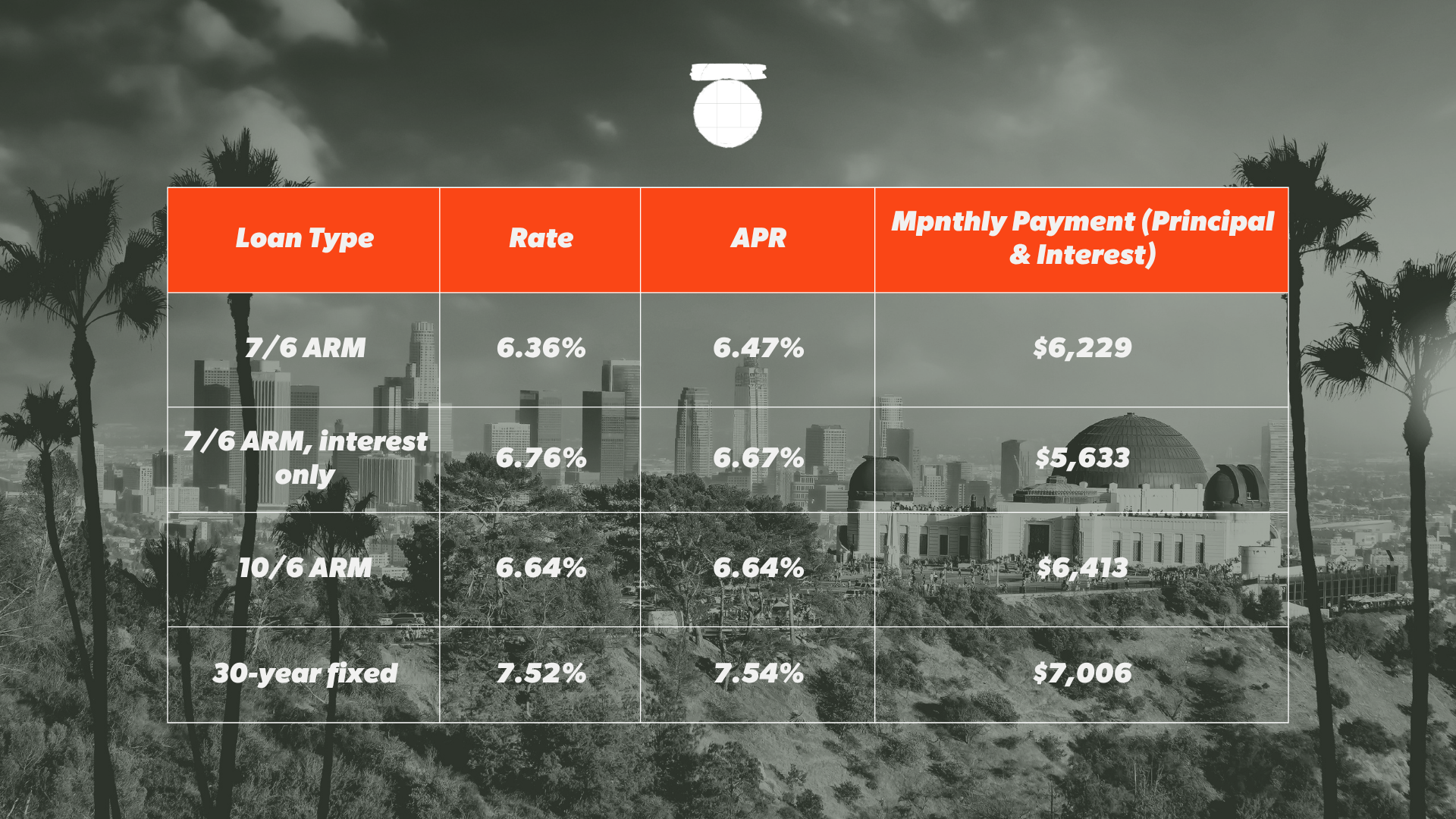
That 30-year fixed jumbo at 7.52% is running well above the 7.03% national average. The 7/6 ARM, on the other hand, comes in more than a full point lower and saves roughly $777 a month on that $1,000,000 loan. Over the 7-year fixed period, that adds up to about $65,000. Scale that up to a $2,000,000 loan and the monthly gap is closer to $1,550.
An ARM (adjustable-rate mortgage) gives you a fixed rate for a set period, 7 or 10 years in these examples, and then adjusts every 6 months after that based on the market. The sheet shows what the payment would look like if the rate reset to 6.50%, but nobody knows where rates will be in 2033, and it could be higher. That's the trade you're making.
For a lot of my clients, it's a trade that makes sense. If you expect to move, refinance, or pay down the loan within 7 to 10 years, you're paying extra for 30 years of certainty that you may never use. If this is your forever home and you want to set it and forget it, the fixed rate still has real value. There isn't a right answer for everyone, but there is a right answer for you, and it's worth running the numbers with your lender before you default to the 30-year.
What 7% Mortgage Rates Mean for the Westside LA Housing Market
If you're buying, don't let the 7% headline make the decision for you. Get pre-approved with a lender who handles jumbo loans, ask to see ARM options side by side with the fixed rate, and look at the monthly payment rather than just the rate. Higher rates also tend to thin out the competition, which can mean more room to negotiate on price and terms.
If you're selling, buyers are doing math on every single showing. Pricing correctly from day one matters more now than it did 2 years ago, because a buyer who's stretching to afford a 7% payment isn't going to chase an overpriced listing. Homes that are priced right are still moving. Homes that aren't are sitting.
If you own and aren't going anywhere, just keep an eye on this week's reports, because if rates do start to ease, the next few months could bring more buyers back into the market.
Frequently Asked Questions
What is the current 30-year mortgage rate? According to Freddie Mac, the average 30-year fixed mortgage rate was 7.03% as of September 24, 2026, up from 6.95% the week before and 6.30% a year ago. It's a national average for conventional loans, so your actual rate will depend on your loan size, down payment, and credit profile.
What are jumbo mortgage rates in Los Angeles right now? On a private bank jumbo rate sheet dated September 25, 2026, the 30-year fixed jumbo rate was 7.52%, while 7-year and 10-year ARMs were 6.36% and 6.64%. That example assumes a $1,000,000 loan, 30% down, and an owner-occupied California home. Jumbo pricing varies by lender and borrower, so compare quotes.
Why are mortgage rates going up if the economy is doing well? A strong economy keeps inflation pressure alive and gives the Fed less reason to cut rates. That pushes Treasury yields higher, and mortgage rates tend to follow the 10-year Treasury yield.
Does the Fed set mortgage rates? No. The Fed sets a short-term rate that banks charge each other. Mortgage rates are driven mainly by the 10-year Treasury yield, although Fed decisions influence how investors price that yield. The Fed raised its rate to a range of 3.75% to 4% on September 16, 2026.
Is an ARM a good idea right now? It can be, especially if you plan to sell, refinance, or pay down the loan within the ARM's fixed period. On a $1,000,000 jumbo loan, a 7/6 ARM was about $777 a month cheaper than a 30-year fixed on the rate sheet reviewed. The risk is that your rate can rise after the fixed period ends, so talk it through with your lender.
Should I wait for mortgage rates to drop before buying in Westside LA? Waiting only makes sense if you have a clear reason to expect lower rates and you're comfortable competing with more buyers when they return. Higher rates often mean less competition and more room to negotiate, and an ARM can lower the monthly payment in the meantime.
What reports could move mortgage rates this week? The August PCE inflation report on Wednesday, September 30, 2026, and the September jobs report on Friday, October 2, 2026. Cooler numbers could help rates ease, while hotter numbers could keep them elevated.
Thinking About Buying or Selling on the Westside?
If you want to see how today's rates change your buying power in Santa Monica, Brentwood, Venice, Mar Vista, or Pacific Palisades, or what they mean for pricing your home, reach out. We'll walk through your numbers together. Call 310-853-2643 or email info@paulsalazargroup.com.
This post is for general information only and is not financial or lending advice. Rates, terms, and payments shown are examples from a single lender rate sheet dated September 25, 2026, based on a $1,000,000 loan, 30% down, and an owner-occupied California property. Payments reflect principal and interest only and don't include taxes or insurance. Your rate and terms will vary, so request an official Loan Estimate from your lender before choosing a loan. Compass is a licensed real estate broker and abides by Equal Housing Opportunity laws.