ADU Cost, Rent & Value on the Westside: A 2026 Guide for LA Homeowners
Before you build a backyard unit, there's one question worth answering honestly: are you okay with a stranger living on your lot?
Attached or detached doesn't really matter, what you're building is a duplex. Most people skip that question entirely and go straight to the money, which is the wrong order. There are 3 questions to answer before you build an ADU in Los Angeles, and here they are in the order that matters. Money is second.
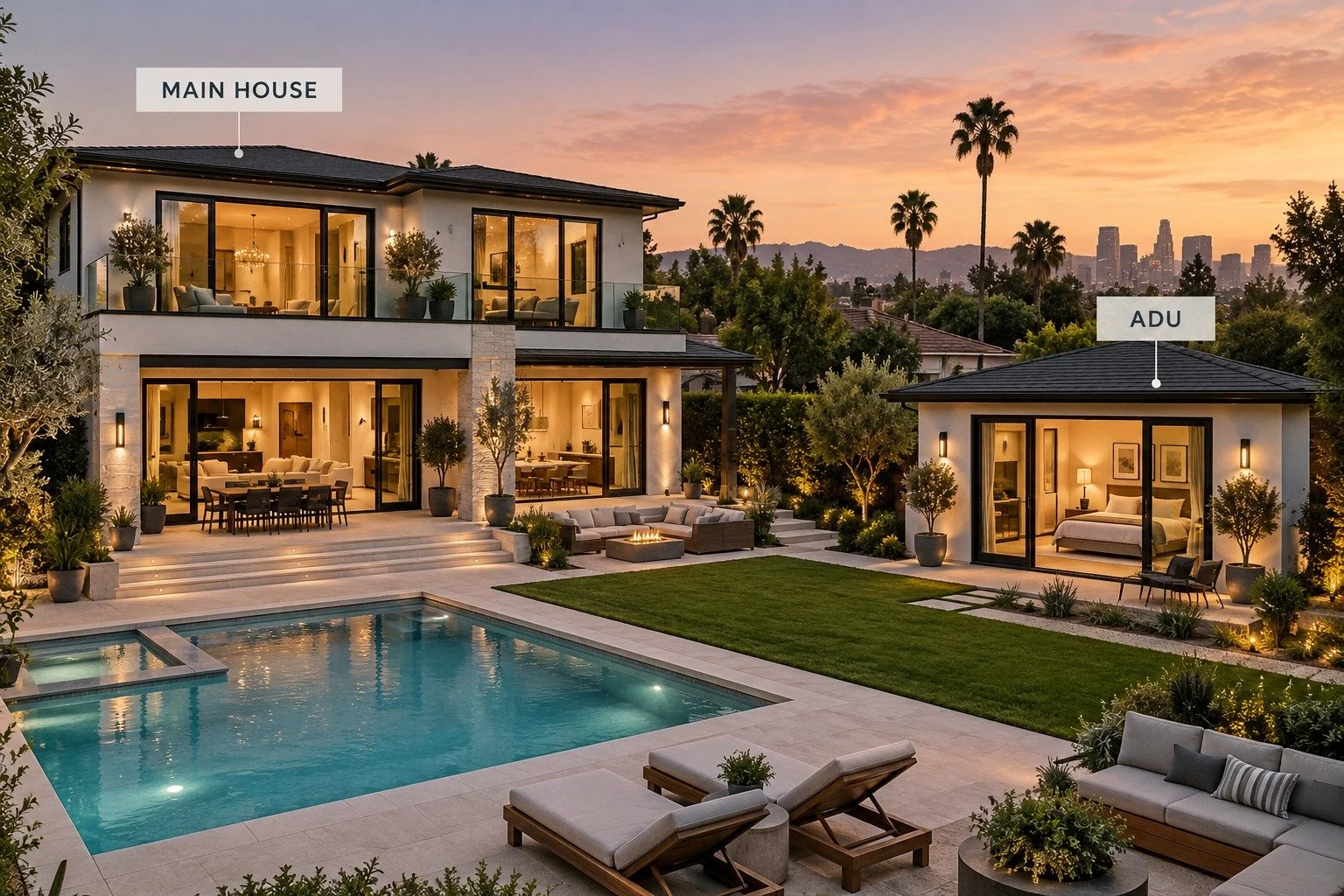
Photo Digitally Rendered
Why ADUs Are Suddenly Everywhere in Los Angeles
This isn't a trend. It's policy. California decided cities weren't building enough housing and took the decision away from them. LA County is supposed to add 812,000 homes by 2029 and has permitted a fraction of that, so starting in 2020 the state stripped out everything that used to kill these projects, owner-occupancy requirements, parking minimums near transit, most impact fees, and the neighbor hearings went with them. Under the California HCD ADU Handbook, an ADU application is now ministerial, meaning that if your plans comply, the city has to approve it.
The response was immediate. USC's Lusk Center annual housing report found LA County finished 10,230 backyard units in 2025, compared to 1,624 in 2018.
ADUs made up 37% of every housing unit that received a certificate of occupancy in the county last year, not 37% of single-family homes, but 37% of everything, apartment towers included. Backyards are now the biggest source of new housing in Los Angeles, and they go from permit to finished in roughly 18 months.
Question 1: How Will It Feel to Live With?
Somebody is going to be living on your property every day, indefinitely. That's the part the cost calculators leave out, and it's worth thinking through first, because when owners are happy with their ADU 5 years later, it's usually because they got this part right at the design stage. The good news is that it comes down to one thing, and it's simpler than you'd think: alley access.
Why Alley Access Is the Single Biggest Factor
Pull up your lot on a map and look at what's behind your house. If there's an alley, you're in great shape. You can site the ADU at the rear of the lot with its own garage off the alley, its own small yard, and its own entrance. Your tenant arrives from behind, parks behind, and enters behind. Functionally, you have two separate properties that happen to share a parcel, and that's the version people love living with.
If there's no alley, the design just needs more intention. Think through the daily path: where your tenant parks, how they reach their door, and what they pass on the way. Getting that route right is the whole ballgame, and it's a design decision, not a budget one.
Same square footage, same build cost, the difference is planning.
Designing for Privacy Without an Alley
Plenty of excellent ADUs sit on lots with no rear access. A few moves do most of the work:
Corner lots handle this beautifully, since the ADU can open onto the side street with its own address and entrance.
A dedicated side path with real screening, fencing, hedging, or a jog in the walkway, is what turns a shared yard into two distinct homes. State law allows 4-foot side and rear setbacks, which usually leaves room to do it properly.
Window orientation away from your main living spaces costs nothing at the design stage and makes a significant difference later.
A junior ADU, converted from interior space, is a strong option when the lot can't deliver rear separation.
And if privacy isn't your priority at all, that's worth knowing too. Most Westside owners use the space for family, an office, or a gym rather than renting it, which, as you'll see below, changes the calculation entirely.
Question 2: What Does an ADU Cost, and What Does It Rent For?
Construction pricing is the one number with no official source behind it. Builders across LA are quoting roughly $300 to $450 a foot for a detached new build, and on the Westside you're at the top of that range. Get 3 bids before believing any of it.
Most owners pay with a cash-out refinance, so look hard at the rate you'd be giving up and the actual return on that money.
ADU Cost vs. Rent vs. Yield: Westside 2026
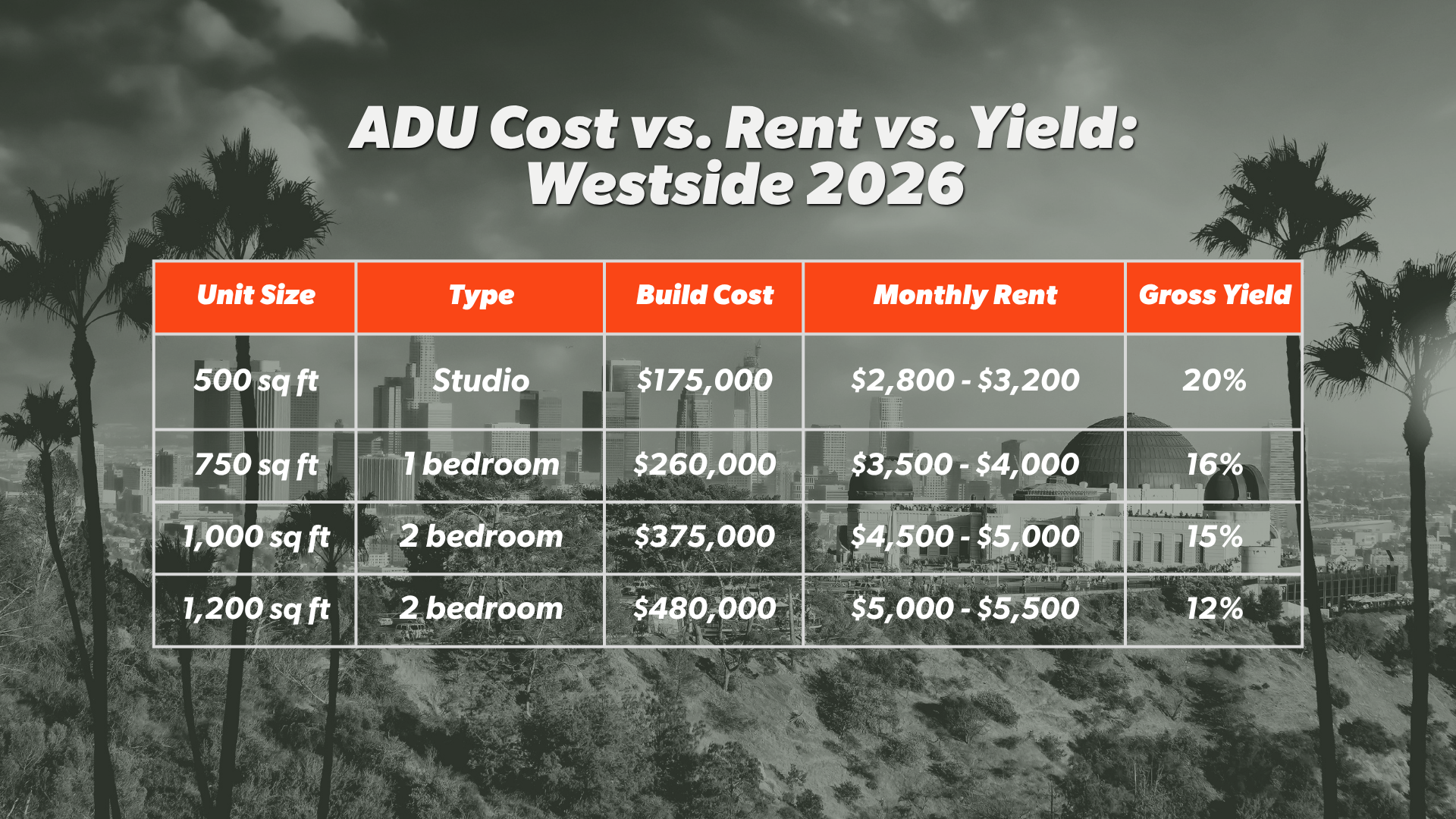
Build costs assume Westside pricing at $350–$400 per square foot. Rents reflect Santa Monica and adjacent Westside submarkets. Gross yield is before taxes, insurance, maintenance, and vacancy.
Why the Rent Figure You'll Find Online Is Wrong
Search Santa Monica rents and Apartment List will give you a median around $2,405, which makes an ADU look like it doesn't pencil.
That figure measures apartment buildings, and Santa Monica's rent control covers everything built before April 1979, so the median is full of long-term tenants in 1960s buildings.
A new ADU is new construction, which means it's exempt from local rent control and prices with the new stock. Look at newer buildings instead and RentCafe puts Santa Monica's 1-bedroom at $3,614 with the 2-bedroom at $4,472.
That matches the field. A 1-bedroom ADU in Santa Monica should get at least $3,500, and north of Montana or closer to the beach, more. A 2-bedroom should get $4,500 to $5,500 depending on location and condition. So $4,000 a month for a 2-bedroom is the floor, not the ceiling.
ADUs by Westside Neighborhood
The economics shift meaningfully block to block.
Mar Vista
The best ADU lots on the Westside, largely because of alley access. Much of Mar Vista has rear alleys, which is what allows a detached unit with its own garage and entrance. Standard 50-by-130 lots comfortably accommodate a 1,200-square-foot unit, and most of the neighborhood sits within a half-mile of transit, so no added parking is required.
Santa Monica
The strongest rents on the Westside, but a separate jurisdiction from the City of LA with its own ADU ordinance and rent control board. City of LA rules referenced here don't apply, confirm requirements with Santa Monica's planning department before designing anything.
Venice
Strong rents and high buyer demand for flexible space, but much of Venice falls inside the Coastal Zone, which adds a coastal development permit to the process. As of late 2025, state law places a 60-day shot clock on those permits, which has meaningfully shortened what used to be the longest part of a Venice timeline.
Pacific Palisades
Construction runs roughly 30% above the LA baseline. For fire-rebuild properties, permit fees are currently suspended under the Mayor's emergency order rather than permanently waived, and the city's rebuild FAQ confirms you can build the ADU and the main house in any order, which lets you get your family back on your land while the main house takes its 3 years.
Brentwood
Larger lots make size less of a constraint, but the Brentwood housing stock skews older. If your main house predates October 1978, see the rent stabilization note below before you build.
Question 3: What Happens When You Sell?
I'd estimate 90% of the owners I know with an ADU aren't collecting a check. It's the in-laws, a gym, an office, or just more room, a completely legitimate reason to build one.
Which brings up what developers figured out. Look at new construction on the Westside and you'll see builders adding ADUs, and junior ADUs, which are units carved out inside the house itself. They're not doing that because the buyer wants a tenant. They're doing it because it makes the property more valuable and gives the buyer options.
Here's the technical piece nobody explains. The Fannie Mae Selling Guide says an appraiser cannot fold ADU square footage into your home's gross living area, so it's valued on its own separate line. The exception is a unit that's attached, above grade, with interior access, which is exactly why the junior ADU is the builder's favorite move.
The value shows up regardless. FHFA appraisal data covering a decade of California appraisals shows that through 2023, the median appraised value of a home with an ADU was $1,064,000 versus $715,000 without one, growing faster at 9.34% a year versus 7.65%.
That isn't clean apples-to-apples, since bigger lots and better neighborhoods are baked in. But the direction has held every year, and it's the most defensible ADU data available.
Small Unit or Big Unit? The Math Points Both Ways
The cash-flow math and the resale math point in opposite directions. As the table above shows, the smaller unit wins on yield every time, because the kitchen, the bathroom, and the permits don't get cheaper just because the box gets smaller.
But the big unit wins on the appraisal, on the buyer pool, and on the day you sell, because 2 bedrooms reads as a second home while a studio reads as a bonus room with a stove.
What makes that size possible on a normal lot is that LADBS doesn't require parking within a half-mile walk of transit, which covers most of the basin.
What You Can Do
If you have an alley: build at the back with its own garage.
If you need income now and you're staying put: build the smaller unit for the better yield.
If you're selling within 5 to 7 years: build the biggest unit your lot allows, 1,200 feet in LA, 2 bedrooms, built like a home rather than a shed.
Two rules regardless. This is a long-term rental only, since the City of LA requires 30 days or more, so don't underwrite it on nightly rates. And permit it properly, because an unpermitted unit doesn't appraise and shrinks your buyer pool to cash. LADBS recently issued a bulletin creating a streamlined path for units built before January 1, 2020.
One item worth raising with an attorney: if your main house was built before October 1978 and you add an ADU and rent it, your property may no longer be treated as a single-family home under LA's rent stabilization rules. Have that conversation before you build.
Frequently Asked Questions
How much does it cost to build an ADU in Los Angeles in 2026?
Builders are quoting $300 to $450 per square foot for detached new construction. A 750-square-foot unit runs around $260,000 and a full 1,200-square-foot unit near $480,000. Westside projects sit at the top of that range, and Pacific Palisades runs about 30% above the LA baseline.
How much can you rent an ADU for in Santa Monica?
A 1-bedroom ADU should rent for at least $3,500 per month and a 2-bedroom for $4,500 to $5,500, depending on location and condition. New ADUs are exempt from local rent control as new construction, so they price alongside newer buildings rather than the citywide median of $2,405.
Does an ADU add square footage to your house?
Not on the appraisal. Fannie Mae guidelines prevent an appraiser from including ADU square footage in the main home's gross living area, so it's valued on a separate line. A junior ADU, carved out inside the house, does count toward your square footage.
Does an ADU increase home value in California?
Yes. FHFA appraisal data through 2023 shows California homes with an ADU at a median appraised value of $1,064,000 compared to $715,000 without one, growing 9.34% annually versus 7.65%.
Do you need parking for an ADU in Los Angeles?
No, not within a half-mile walk of transit, which covers most of the LA basin. LADBS does not require added parking for an ADU in those areas.
How big can an ADU be in Los Angeles?
Up to 1,200 square feet for a detached unit.
Can you rent an ADU short-term in Los Angeles?
No. The City of LA requires rentals of 30 days or more, and home-sharing rules block most short-term ADU use.
Is an ADU a good investment on the Westside?
It depends on your timeline. A smaller unit produces the better rental yield, while a larger 2-bedroom unit produces the better resale outcome. If you're selling within 5 to 7 years, build bigger.
Let’s Talk!
Thinking about what an ADU would do to your property? To Learn more, connect with us at 310-853-2643 or at info@paulsalazargroup.com.