When Are LA County Property Taxes Due in 2026?
LA County's 2026 27 property tax bill comes in two installments. The first is due November 1, 2026 and becomes late after December 10, 2026. The second is due February 1, 2027 and becomes late after April 12, 2027. That is the simple part. The part that catches Westside buyers off guard is a different bill altogether.
The tax bill buyers don't see coming
This happens all the time, and it happens most with trust sales. When someone passes away, the house is usually owned by someone in their 70s, 80s or 90s who has been there for 30-50 years or longer. They bought it for $30,000, $50,000, $100,000 or $200,000, and today it's worth between $2 million- $5 million.
The seller's property tax bill reflects that old purchase price. The new buyer's bill will not. When the house changes hands, the county reassesses it at the new price and sends a separate bill to make up the difference, called the supplemental tax bill.
A lot of buyers get that bill and have no idea what it is, because their agent never explained it. They did sign paperwork during escrow acknowledging it would come, but there is so much going on in a transaction that it gets lost. Even when you tell buyers, they often forget. So I tell every buyer I work with, before they close, that a supplemental tax bill is coming on top of the regular property tax bill, and roughly when to expect it. Nobody should be surprised by a big bill showing up after they get the keys.
When are LA County property taxes due in 2026?
The Treasurer and Tax Collector mails the annual secured property tax bill in October, and state law requires it to go out no later than November 1 . The tax year runs July 1 through June 30, so the bill arriving this fall covers July 1, 2026 through June 30, 2027 (LA County TTC).
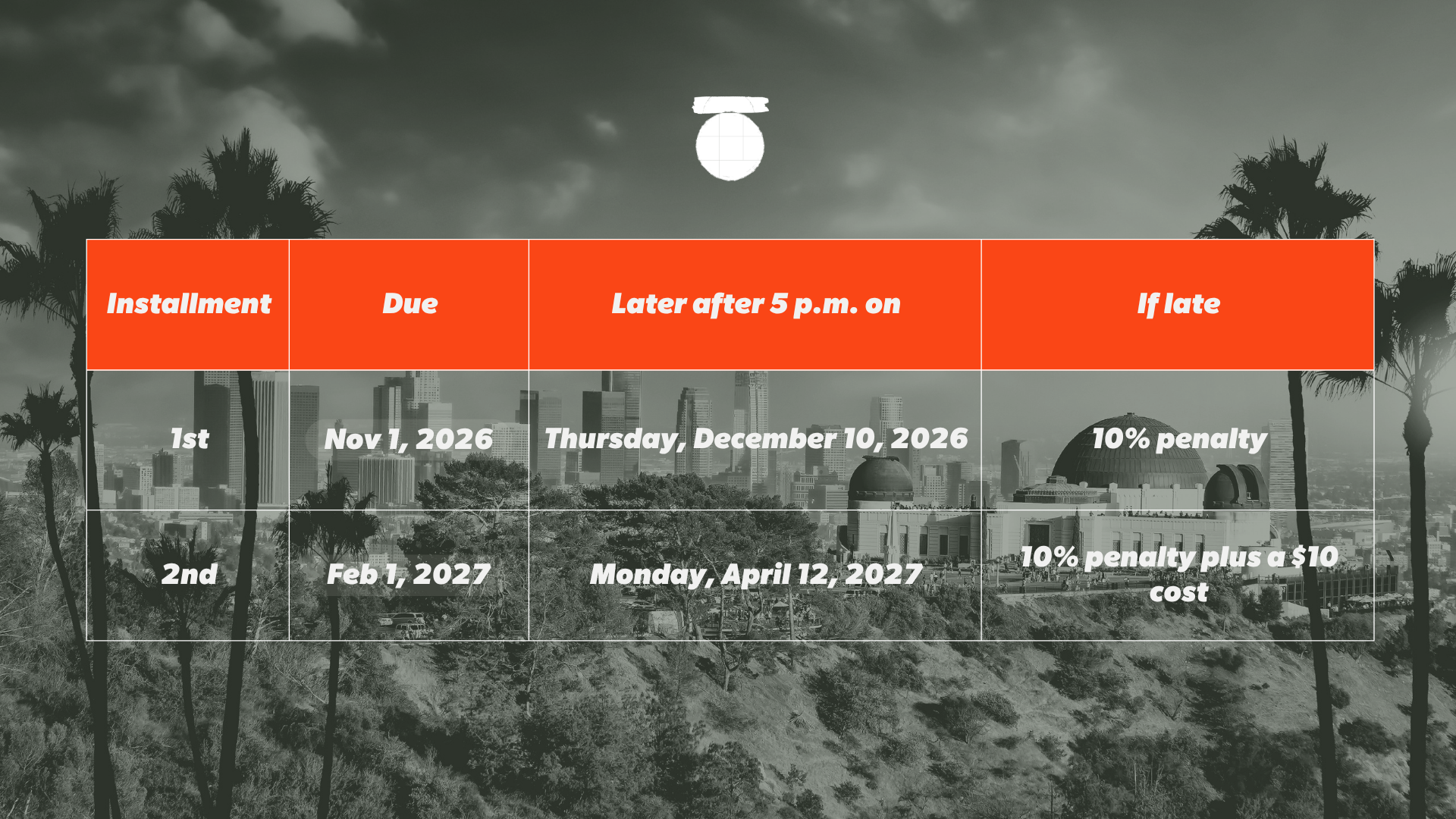
The usual deadlines are December 10 and April 10, and a payment counts as on time if the county receives it or the USPS postmarks it by that date . When a delinquency date lands on a weekend or holiday, it moves to the close of business on the next business day, which is why the second installment this cycle runs to April 12. Anything still unpaid on July 1 goes into default, which adds a $15 redemption fee and 1.5% interest per month until it's paid. If your taxes are paid through your mortgage impound account, your lender handles these two installments. If not, you can pay online at ttc.lacounty.gov.
What will my property taxes be on a $3 million Westside home?
I tell buyers to estimate their property taxes at about 1.25% of the purchase price per year. On a $3 million home, that works out to roughly $37,500 a year, or about $18,750 per installment. It won't be exact, but it's a reliable ballpark for planning. The reason it's 1.25% and not a flat 1% is that every bill starts with the general 1% levy that applies to every property in the county (LA County Property Tax Portal), and then voter-approved bonds and local assessments are added on top. Those extras vary by location, so the total varies by neighborhood.
Playa Vista is the main exception on the Westside. It's a newer community, so it carries additional charges tied to its development, including a Mello-Roos special tax that the City of Los Angeles levies each year through Community Facilities District No. 4 (Playa Vista–Phase 1) (LA City Clerk). Buyers there should expect a total noticeably higher than 1.25%, so ask for the current tax bill and check what the special taxes add.
For a closer number, the LA County Assessor has a free Supplemental Tax Estimator. You enter the property's street address or its 10-digit Assessor Identification Number, and it estimates the supplemental taxes you can expect after a recent purchase.
It's built for changes in ownership, not new construction, and it won't give a reliable estimate if the property sold more than once in a calendar year or only part of it changed hands.
One more thing to do after you close: if the home is your primary residence, file for the Homeowners' Exemption. It takes $7,000 off your assessed value, which saves about $70 a year, and February 15 is the deadline to get the full amount (NBC Los Angeles).
What is a supplemental tax bill, and when does it come?
A supplemental tax bill is an extra bill the county issues when a property is reassessed because it changed ownership or new construction was completed (LA County TTC). It covers the gap between the seller's old assessed value and your purchase price, for the months you've owned the home that the regular bill didn't account for.
It arrives on its own schedule, separate from the November bill. If you close between January 1 and May 31, you'll get two supplemental bills instead of one, and the second one covers the following tax year.
Here's a simplified illustration of why it can be large. Say a trust sells a Westside home the family bought decades ago, and its assessed value today is around $300,000. You buy it for $3 million and close in March. The difference is $2.7 million, and at roughly 1.25%, that's about $33,750 a year in tax the seller's bill never reflected. Because you closed in March, you'd get one bill for the rest of the current tax year and a second for the full year after, so the total can run into the tens of thousands on top of your regular installments. The Assessor's estimator above will give you the real figure for a specific property.
The most important detail: your lender will not pay it. Even if your regular taxes run through an impound account, the county tells owners not to expect their lender to pay supplemental bills. It's mailed to you, and you pay it directly.
Supplemental bills are also paid in two installments, but the deadlines depend on when the bill is mailed. A bill mailed July through October follows the regular December 10 and April 10 dates. A bill mailed November through June has a first installment due by the last day of the month after it was mailed. The exact dates are printed on the bill, so open it the day it arrives.
What I tell buyers before they close:
Budget for your property taxes at about 1.25% of the purchase price, not the seller's number.
Set aside money for the supplemental bill, which comes separately and isn't covered by your impound account.
Run the address through the Assessor's estimator so the number isn't a guess.
If you close between January and May, expect two supplemental bills.
Do Palisades fire owners still pay property taxes this fall?
Yes, the 2026–27 bills follow the normal schedule, but many fire-affected owners are paying on a lower assessed value. Property taxes aren't a big topic among Palisades owners right now, from what I'm hearing from homeowners and the agents who work there. Most of them know their deadlines, and many have already had their assessments reduced because there's no house on the lot anymore.
That reduction comes from California's disaster relief rules. When a fire damages or destroys a home through no fault of the owner, the Assessor can reappraise it to reflect its damaged condition, as long as the loss is at least $10,000 and the owner filed a claim within 12 months. Owners still have to pay their regular bill unless an executive order says otherwise (CA Board of Equalization). The Governor's January 2025 order let owners in the affected ZIP codes postpone property tax payments until April 10, 2026, so this fall's installments are back on the regular calendar.
If you're rebuilding, there's good news on timing. A home rebuilt in a similar way keeps its prior assessed value, and AB 245, in effect since January 1, 2026, gives 2025 Palisades fire owners three extra years on top of the standard five to rebuild on the same site and keep that value. That extra time matters for anyone stuck in permitting or insurance. If you're buying a Palisades lot, none of that carries over to you. A purchase is a change in ownership, so the lot is reassessed at your price, and the same supplemental bill rules above apply.
The bottom line
If you already own on the Westside, mark December 10, 2026 and April 12, 2027 on your calendar. If you're buying, plan for about 1.25% of your purchase price each year, and set money aside for the supplemental bill before you close, not after it shows up.
Buying on the Westside?
Before you write an offer, we'll run the numbers with you. Call or text 310-853-2643 or email info@paulsalazargroup.com.
Frequently asked questions
When is the first installment of LA County property tax due in 2026? The first installment is due November 1, 2026 and becomes delinquent after 5 p.m. on Thursday, December 10, 2026. A late payment adds a 10% penalty (LA County Property Tax Portal).
Why is the second installment deadline April 12, 2027 instead of April 10? April 10, 2027 falls on a Saturday. When a delinquency date lands on a weekend or holiday, LA County moves it to the close of business on the next business day (LA County TTC FAQ).
Does my mortgage impound account pay the supplemental tax bill? No. The supplemental bill is mailed to you, and LA County tells owners not to expect their lender to pay it, even if regular taxes are impounded (LA County TTC key dates). Plan to pay it yourself.
How do I estimate my supplemental tax bill in LA County? Use the LA County Assessor's Supplemental Tax Estimator and enter the property's address or Assessor Identification Number (LA County Assessor). It's designed for recent purchases, not new construction.
What is the property tax rate in Los Angeles County? Every property pays the general 1% levy, plus voter-approved bonds and local assessments that vary by area (LA County Property Tax Portal). On most of the Westside, about 1.25% of the purchase price is a good working estimate; newer communities like Playa Vista run higher because of special taxes.
Why did I get two supplemental tax bills? If you bought between January 1 and May 31, the county issues two supplemental bills: one for the rest of the current tax year and one for the following year (LA County Property Tax Portal). Both have to be paid in addition to your regular annual bill.