SB 79 and Westside Los Angeles Real Estate: What Actually Changed on July 1, 2026
Short answer: SB 79, California's Abundant and Affordable Homes Near Transit Act, took effect July 1, 2026 and allows buildings up to nine stories within 200 feet of a Metro B or D Line stop, overriding local zoning. But in Westside Los Angeles, both the City of Los Angeles and Santa Monica adopted ordinances delaying full application until roughly 2030, and SCAG's official map confirms Pacific Palisades is not affected.
I'm Paul Salazar, a Compass agent on the Westside. I've had a version of this conversation about forty times since July, usually starting with someone convinced a tower is going up next door. Sometimes they're close. Usually they're a half-mile off, which, as you'll see, is exactly the distance that matters.
So here's what the law actually says, and what it means for your street.
SB 79 Explained: California's New Transit Housing Law
Most housing laws ask cities nicely. This one doesn't.
SB 79 sets minimum height and density standards near major transit stops and preempts local zoning to enforce them. It was signed in October 2025 and took effect July 1, 2026. According to the California Department of Housing and Community Development, which oversees compliance, it's codified in Government Code sections 65912.155 through 65912.162 and makes qualifying transit-oriented housing an allowed use on residential, mixed-use and commercial sites near specified transit stops in urban transit counties. torklawca
Allowed is the word doing the heavy lifting. Not "encouraged." Not "considered." Allowed, meaning a project that pencils under SB 79 doesn't have to win a zoning argument it would have lost two years ago.
It applies immediately in Los Angeles, Alameda, Sacramento, San Diego, San Francisco, San Mateo and Santa Clara counties. Supporters, per bill author Senator Scott Wiener, argue it makes roughly 1.5 million additional homes possible statewide.
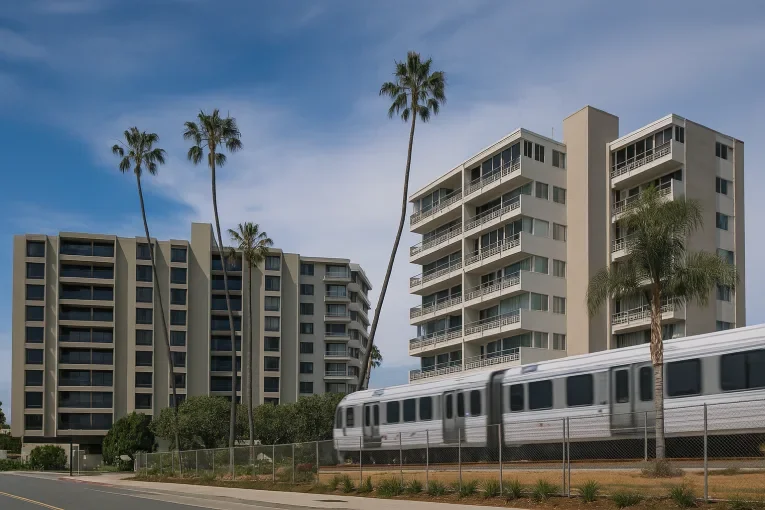
SB 79 Height Limits and Tier 1 vs. Tier 2 Transit Stops
Everything comes down to two things: what kind of train, and how far away.
Tier 1 - Metro B and D Line stops, allows nine stories within 200 feet.
Tier 2 - light rail and dedicated bus lane stop, allows eight stories within 200 feet, six within a quarter-mile, and five within a half-mile. In Los Angeles, only the B and D Line subways hit Tier 1.
Notice how fast that steps down. Nine stories at 200 feet is dramatic. Five stories at a half-mile is a mid-size apartment building, and half a mile is a ten-minute walk. Two properties on the same street can land in completely different worlds.
There are strings attached, too. According to CA YIMBY, which sponsored the bill, all SB 79 projects must meet a minimum affordability standard, and the law prohibits demolishing rent-stabilized buildings of three units or more, or multifamily housing tenanted in the last seven years. California YIMBY
SCAG published its official Transit Oriented Development map on June 1, 2026. Look yours up. It takes two minutes and it settles most arguments.
SB 79 in Santa Monica, Brentwood and Beverly Hills: Three Cities, Three Answers
This is where it gets interesting, because three cities I work in daily read the same law and did three completely different things.
Los Angeles hit pause. Per Los Angeles City Planning, the City Council adopted a Low-Rise Ordinance and a Phased Implementation Ordinance on June 23, 2026, effective June 30, implementing SB 79 locally by 2030 while expanding incentives within half-mile buffers of eligible stations and excluding Historic Preservation Overlay Zones. Per the Los Angeles Conservancy, the practical result is two-to-four story multifamily at more than 50 station areas while full application is postponed citywide. Translation: Brentwood, Mar Vista and Venice bought about four years.
Santa Monica did the same, more quietly. Per the city's SB 79 page, the Planning Commission recommended a temporary exclusion ordinance on June 17, 2026, and Council held its hearing July 14, delaying SB 79 on qualifying sites until 2030, one year after adoption of the 7th Cycle Housing Element.
Beverly Hills tried something bolder and got told no. Rather than delay, the city wrote its own plan, one that pulled density off single-family streets and pushed it toward the commercial edges. Per the city's planning page, it submitted that plan to HCD in February 2026 and received a comment letter May 8 with a July 7 deadline to respond. Holland & Knight puts it bluntly: HCD found the plan did not substantially comply, citing density capacity and rent-stabilized sites. And both Beverly Hills stops, Wilshire/La Cienega and Wilshire/Reeves, are Tier 1. Nine-story tier, in Beverly Hills, with the city's workaround currently rejected.
That one's worth watching.
Pacific Palisades Is Not Affected by SB 79
Flatly, definitively: SCAG's official map confirms SB 79 has no impact on Pacific Palisades. The claim that it would bring high-rises to the Palisades circulated during the mayoral race and it was never true. If you're rebuilding there, SB 79 isn't a variable in your math. Insurance, permitting timelines and construction costs still are.
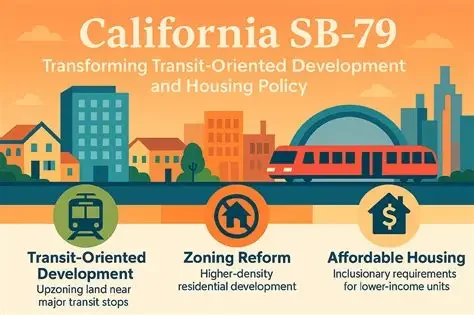
The D Line Subway Extension and Why Wilshire Is Different
Zoning changes are abstract until a subway shows up. On Wilshire, one is.
According to LA Metro, the D Line extension runs nearly nine miles from Wilshire/Western in Koreatown to Westwood, and Section 1 opened May 8, 2026 with stations at Wilshire/La Brea, Wilshire/Fairfax and Wilshire/La Cienega. Metro reports Section 2, Beverly Drive and Century City, is about 83% complete and targeted for spring 2027, while Section 3, adding Westwood/UCLA and Westwood/VA Hospital, is about 75% complete and targeted for fall 2027. Fully built, Metro projects roughly 78,000 daily riders and a 25-minute trip from Westwood to Downtown.
Twenty-five minutes to Downtown from Westwood. That number rewrites some people's commute math entirely, and it's why the Wilshire corridor is the part of this story with actual teeth.
The Westwood/VA Hospital station sits at the West Los Angeles VA campus, minutes from Brentwood.
Traffic on the Westside: My Honest Read
Here's where I'll disagree with the optimists.
Near-term, this adds traffic. People who move into a building above a Metro stop in Los Angeles still own cars, this is not New York, and one subway line doesn't change that. I expect to see it on Wilshire and Santa Monica Boulevard first.
That's not an argument against the law. We've needed housing here for a long time and that hasn't changed. It's just what I think happens between now and whenever the transit habit catches up to the transit.
A July 2026 analysis from TorkLaw frames the split fairly: critics expect strain on roads, parking and emergency access, supporters expect driving to decline over time, and there's no evidence yet either way. Both sides are currently arguing about a future neither has measured.
SB 79 and Westside Luxury Home Values
The question I get most, and the one with the least satisfying answer: it depends on your parcel. Not your neighborhood. Your parcel.
The thing that moves value here isn't who moves in, it's build form. Years of construction staging. Five-to-nine-story massing next to properties that have never had a neighbor above two stories. Light, privacy and sightlines are what get repriced.
A home two blocks off a Tier 1 stop with mature landscaping and no shared view corridor is a different asset than one directly abutting a qualifying site. Same zip code, different answer.
Anyone telling you SB 79 will uniformly lift or sink Westside values is guessing.
What Westside Homeowners Should Do Now
Look up your parcel on the SCAG map. Then check your city's ordinance, because Los Angeles, Santa Monica and Beverly Hills are on three separate tracks and one of them is in an active dispute with the state.
If you're within a half-mile of a qualifying stop and thinking about selling in the next 24 months, that delay window is a real advantage, and it has an expiration date on it.
Frequently Asked Questions About SB 79
Does SB 79 apply to my Westside Los Angeles home right now?
In the City of Los Angeles and Santa Monica, most likely not yet. Both adopted ordinances delaying full SB 79 application until approximately 2030, with Los Angeles permitting two-to-four story projects around more than 50 station areas in the interim. Beverly Hills pursued a TOD alternative plan instead, and HCD found it non-compliant in May 2026.
How tall can buildings be under SB 79 near my house?
Nine stories within 200 feet of a Metro B or D Line stop (Tier 1). Tier 2 stops allow eight stories within 200 feet, six within a quarter-mile, and five within a half-mile. Local delay ordinances can suspend these standards.
Is Pacific Palisades affected by SB 79?
No. SCAG's official Transit Oriented Development map, published June 1, 2026, confirms SB 79 has no impact in Pacific Palisades.
Did Beverly Hills opt out of SB 79?
It tried. Beverly Hills adopted a TOD alternative plan shifting density off single-family sites. HCD issued findings on May 8, 2026 that the plan did not substantially comply with SB 79, citing density capacity and rent-stabilized site deficiencies, and gave the city until July 7 to respond.
When does the D Line subway reach Westwood?
Metro is targeting fall 2027 for Section 3, adding the Westwood/UCLA and Westwood/VA Hospital stations, ahead of the 2028 Olympic Games. Section 1 opened May 8, 2026.
Will SB 79 lower property values on the Westside?
There is no uniform answer. The relevant variables are parcel-specific: proximity to a qualifying stop, construction exposure, and whether five-to-nine-story massing affects light, privacy or sightlines on that particular property.